Food-related symptoms can have several explanations, including food allergy, food intolerance and irritable bowel syndrome (IBS). As nutritionists, we use a combination of your symptoms, food history and, where appropriate, intolerance or sensitivity testing to help identify which foods may be worth exploring. An IgG result is one piece of information rather than a diagnosis, but it can help guide a focused elimination and reintroduction plan.
As nutritionists, we know it is understandable to look for a clear answer when eating leaves you uncomfortable, especially when test results point towards particular foods. This article explains how allergy, intolerance and IBS differ, how IgG and IgE antibodies differ, and how food sensitivity testing may help guide dietary changes for people with IBS. It also explores how a carefully planned elimination diet, followed by structured reintroduction, can help investigate symptoms without creating unnecessary restrictions.
Key Takeaways
- Learn how the timing and type of symptoms can help distinguish a food allergy from an intolerance.
- See how a food and symptoms diary can help uncover patterns linked to IBS.
- Understand how IgG and IgE results differ and how IgG testing may help identify foods to explore in an IBS-focused dietary plan.
- Find out how nutritionists use focused elimination and structured reintroduction to investigate symptoms while keeping dietary restrictions manageable.
Avoiding unnecessary dietary restriction
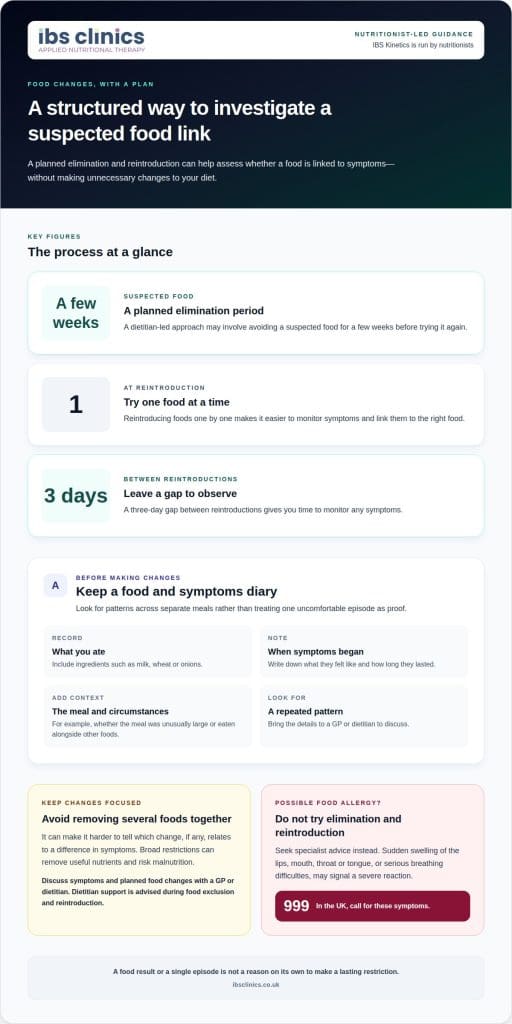
Removing a food may feel like a practical response to discomfort, but changing several parts of your diet at once makes it harder to identify what is helping. As nutritionists, we use a focused approach: we consider your symptoms, food history and, where appropriate, test results before selecting foods to explore. This keeps the elimination phase manageable and makes the reintroduction findings more useful.
A food and symptoms diary can make the investigation more specific. Record what you ate, when symptoms began, what they felt like and how long they lasted. For example, note whether discomfort followed milk, wheat or another ingredient, and whether the same pattern appeared again. We use these details alongside any test results to decide which foods to explore first.
Elimination diets are a tool we commonly use as nutritionists. If intolerance or sensitivity is suspected, a planned elimination and reintroduction can help assess the link. NHS guidance describes a dietitian-led approach that may involve avoiding a suspected food for a few weeks, then eating it again to see whether symptoms return. Reintroducing the food is an important part of the assessment. In practice, we reintroduce one food at a time and leave a 3-day gap between reintroductions, so symptoms can be monitored and linked to the right food. A dietitian or nutritionist can help structure the process and consider suitable alternatives. Our step-by-step guide to reintroducing foods explains the process in more detail.
Do not try elimination and reintroduction if you suspect a food allergy. Seek specialist advice instead. Sudden swelling of the lips, mouth, throat or tongue, or serious breathing difficulties, may signal a severe reaction. In the UK, call 999 for these symptoms, according to the UK Government.
Broad restrictions can remove useful sources of nutrients and make everyday meals harder to manage. For example, cutting out milk and wheat together may not show which food, if either, is linked to symptoms. We use testing, symptom records and a focused elimination plan to minimise the number of foods removed before structured reintroduction. This helps keep the diet balanced while giving each food a fair opportunity to be assessed.
This is where intolerance or sensitivity testing can fit into our work as nutritionists. Used alongside your symptoms and diary, a result can help us decide which foods to look at first, so we minimise the number of foods removed before the structured reintroduction phase begins. The test does not replace elimination and reintroduction; it helps keep the elimination phase as narrow and practical as possible.
Differences between food intolerance and food allergy
A food allergy involves the immune system reacting to a food. Intolerance is different: it is not caused by an immune overreaction and cannot cause a serious allergic reaction. Lactose intolerance is the most common food intolerance. Symptoms may include digestive discomfort and usually begin a few hours after eating the trigger, according to the NHS. They can last a few hours or days. We use the timing and type of symptoms to help decide which explanation is most relevant.
What tests are available in the UK? Assessment depends on the suspected cause. Tests for possible intolerance may include blood tests, or a breath test if lactose intolerance is suspected. Commercial IgG blood tests are also available and can provide information to use alongside symptoms and food history. Guts UK has questioned how accurately these tests identify intolerance, while published research in people with IBS supports using IgG-guided elimination to guide dietary changes.
Home tests can sound convenient, but the useful interpretation comes from considering the result alongside your symptoms and eating history. The NHS does not recommend some home tests that claim to diagnose intolerance because evidence for accurate results is limited. Applied kinesiology, hair analysis and leukocytotoxic testing also lack a sound basis for identifying food intolerance, according to Guts UK. An IgG-based food sensitivity test is best used as part of a broader nutrition assessment rather than in isolation.
Can you access testing through the NHS? If you or your child has recurring symptoms, see a GP. A GP may refer someone with suspected intolerance to a dietitian; assessment may include blood tests or a lactose breath test. For suspected allergy, seek specialist advice rather than trying food exclusion and reintroduction. Your symptom pattern and the suspected food help guide the assessment.
A test result is most useful when it helps create a focused plan rather than a long list of permanent exclusions. We combine the result with your symptoms and food diary to identify foods to explore, then use elimination and structured reintroduction to assess the pattern. This approach helps keep changes manageable and supports a balanced diet. For help making sense of digestive symptoms, consider talking through your symptoms.
IBS and food-related symptoms
With IBS, digestive symptoms may follow a meal, and some people also have food intolerances or sensitivities. Guts UK notes that some people with IBS have lactose intolerance or fructan intolerance. Fructans occur in foods such as wheat, while lactose is found in milk. These overlapping issues may help explain why some people feel better after removing milk or wheat. As nutritionists, we use this information to guide an individual assessment rather than assuming the same foods affect everyone.
A food and symptoms diary can help you notice patterns to discuss with a nutritionist or other health professional. Record each meal or snack, including ingredients such as milk, wheat or onions. Note when symptoms begin, what they feel like and how long they last. Add relevant context, such as whether the meal was unusually large or eaten alongside other foods. We use this record alongside test results to identify which foods may be worth exploring first.
Look for patterns across separate meals rather than drawing conclusions from one uncomfortable episode. For example, note whether symptoms follow foods containing milk or occur after meals with wheat. Record foods eaten together, too. If several ingredients appear in the same meal, a focused test-guided elimination can help assess them more clearly. The diary is a starting point for a structured nutrition plan.
Keep the record practical and include foods you tolerate as well as those you suspect. That gives a fuller picture than a list of avoided ingredients. Guts UK identifies lactose-free cow’s milk as suitable for people with IBS, so avoiding all dairy is not automatically necessary. We can use your notes and any test results to decide what to explore, then support careful reintroduction so your diet remains as varied as possible.
IgG blood testing
An IgG panel tests for reactions to selected foods and presents the results as a list. That list can provide a useful starting point, especially when it aligns with familiar symptoms and eating patterns. A result shows an IgG response, and we interpret it alongside your food history rather than treating it as a diagnosis. This helps us select foods for a focused elimination and reintroduction plan.
For people with IBS specifically, we also look at published research. In 2025, a multicentre, randomised, double-blind, sham-controlled trial of 223 IBS patients was published in Gastroenterology, one of the field’s flagship journals. IgG-guided elimination outperformed a sham elimination diet, with 59.6% versus 42.1% meeting the primary pain endpoint (Singh et al., 2025). As nutritionists, we see this as published research supporting the use of food sensitivity testing to guide dietary changes in IBS.
It helps to know how the two main antibody types differ. IgE antibodies are linked to food allergy: the immune system reacts quickly, often within minutes, and the reaction can be serious. IgG antibodies are a different type that the body produces in response to many substances, including foods we eat regularly. Finding IgG to a food is not the same as identifying an allergy, but in people with IBS an IgG result can be considered alongside symptoms when planning dietary changes.
Guts UK says there is no strong evidence that commercial IgG blood tests accurately identify food intolerance, and it notes that people may test positive for foods they eat regularly. We take this context into account when interpreting a report. Published research in people with IBS has also found that IgG-guided elimination can outperform a sham elimination diet, so the result can be useful when it is incorporated into a structured nutrition plan rather than used as a standalone diagnosis.
Blood tests are not all interchangeable. Tests for suspected food intolerance may include blood tests, but the appropriate assessment depends on the suspected cause and the person’s symptoms. A commercial IgG panel provides one type of information, which we consider alongside the clinical picture, food diary and planned reintroduction. The name of the test and the question it is intended to answer matter.
Use your symptoms and food history alongside the report when deciding next steps, rather than treating a colour-coded result as a permanent list of foods to avoid. Note what you ate, when symptoms appeared and whether the pattern recurred. We can then use the report and your observations to select a focused elimination, followed by reintroduction one food at a time with a 3-day gap between foods.
If digestive symptoms remain difficult to interpret, explore personalised gut health testing as part of a broader investigation with nutritionist support.
IBS Clinics: Free 15 Minute Intro chat / ask your questions
IBS Clinics’ nutritionists can help you make sense of persistent digestive symptoms and food-related concerns. If an IgG result has left you unsure what to eat, or you are considering removing foods, we can help you use the information to create a focused elimination and structured reintroduction plan.
IBS Clinics offers IBS care, Gut Health Tests and Special Diets, with support shaped around your symptoms and circumstances. You can use the Free 15 Minute Intro chat to ask questions and discuss how testing, food records and a nutrition-led elimination plan may fit your situation.
If you’d like to discuss your questions, visit ibsclinics.co.uk.
Take a measured next step
Food-related symptoms can make everyday decisions, such as planning meals or eating with others, feel tiring. Keep the next step manageable by focusing on the question you most want answered. An IgG-based food sensitivity test can provide a detailed report, which we can consider alongside your symptoms, eating habits and overall health to identify foods for focused exploration.
If uncertainty is making it difficult to decide what to do, a conversation can help you organise your concerns and consider a practical way forward. Bring a symptom diary or test report, and explain which foods you are worried about and how symptoms affect daily life. IBS Clinics offers a Free 15 Minute Intro chat to ask questions and discuss nutritionist support.
Contact IBS Clinics to discuss your next step. We can help you use food sensitivity information thoughtfully and work towards a clear, structured dietary plan.
Frequently Asked Questions
What is a food sensitivity test, and how does it differ from a food allergy test?
A food sensitivity test may measure IgG antibodies to selected foods, whereas allergy testing involves a different immune response, IgE. The two tests are not interchangeable: an IgG result does not diagnose a food allergy. In an IBS nutrition assessment, however, an IgG report may help identify foods to explore through focused elimination and structured reintroduction.
Are food sensitivity tests scientifically validated and reliable?
Commercial IgG tests are interpreted differently by different organisations, and Guts UK says they are not established as reliable ways to identify food intolerance. At the same time, published research in people with IBS supports using IgG-guided elimination to guide dietary changes. We consider a result alongside your health history and symptom pattern, then use a structured reintroduction rather than treating the report as a permanent list of foods to avoid.
How much do private food sensitivity tests cost in the UK?
There is not one price for all private tests in the UK. The cost depends on the test, the foods included and whether professional interpretation or follow-up support is part of the service. A broader panel may assess more foods, and nutritionist support can help turn the results into a focused elimination and reintroduction plan. Check what the quoted fee covers before deciding whether the test meets your needs.
Which foods do commercial food sensitivity tests typically test for?
Food panels differ, so there is not one standard list across commercial tests. IBS Clinics’ Premium Food Intolerance Test measures IgG antibodies to over 200 foods, including egg, milk, wheat and soy. These are foods included in that specific panel. We consider the results alongside symptoms and eating history to decide which foods to explore through a structured nutrition plan.

Article by
Tracey Randell
Tracey Randell is a Registered Nutritionist and IFM Certified Practitioner (Dip BCNH, IFMCP, mBANT, CNHC), specialising in complex digestive health. She founded IBS Clinics in 2011 and has spent more than 15 years supporting people with SIBO, IMO, SIFO, dysbiosis and long-standing IBS, many of whom have tried several approaches without lasting improvement.
Tracey’s approach is terrain-first. She looks beyond symptoms to the whole gut environment, including digestion, motility, the microbiome, blood sugar and stress. She works with clients across the UK via Zoom, alongside GPs and consultants where appropriate.