
More supplements don’t necessarily mean better support. Useful supplement recommendations depend on your diet, health context and the evidence for a particular nutrient, not on taking a long list of products. Supplements are taken alongside food to provide nutrients or other ingredients, but they aren’t automatically needed by everyone.
It’s understandable to feel unsure when you’re managing persistent digestive symptoms and hearing different advice. Ask what a supplement is intended to do, how strong the evidence is, whether it fits your diet and whether its potential benefit justifies the ongoing cost. Supplements can’t replace investigating symptoms or eating a varied, balanced diet.
This guide explains how to weigh these questions and consider magnesium and other minerals in light of different diets and goals. It also covers why your wider digestive health and possible interactions with medicines matter, so you can make supplement choices with more clarity and less pressure to take everything.
Key Takeaways
- Consider magnesium in the context of your diet and overall needs, rather than assuming everyone benefits from the same supplement.
- Learn how mineral forms, including chelated minerals, differ and what to consider alongside food sources.
- Weigh the quality of evidence, likely relevance to your goals and ongoing cost before choosing a supplement.
- Dietary needs vary with circumstances such as pregnancy or a plant-based diet, so targeted choices may be more useful than taking multiple products.
1. Magnesium intake and supplementation
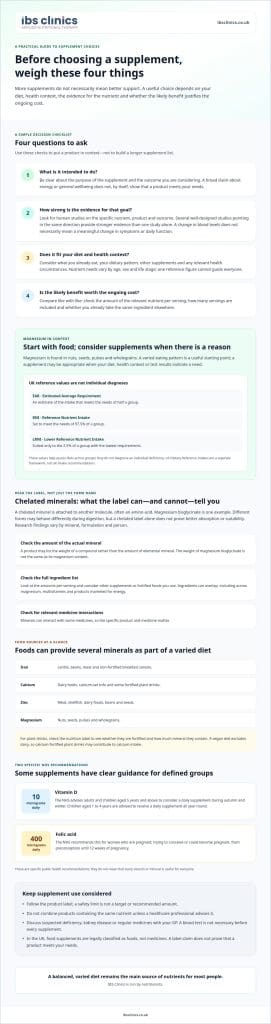
Magnesium needs vary with age, sex and life stage, so one figure cannot guide everyone. In the UK, Estimated Average Requirements (EARs) estimate the intake that meets the needs of half a group. Reference Nutrient Intakes (RNIs) are set to meet the needs of 97.5% of a group, while Lower Reference Nutrient Intakes (LRNIs) suit only the 2.5% with the lowest requirements.
UK reference values help assess diets across groups; they don’t diagnose an individual deficiency. Magnesium is found in foods such as nuts, seeds, pulses and wholegrains. A varied eating pattern is a useful starting point, while a supplement may be appropriate when your diet, health context or test results indicate a need.
The US Dietary Reference Intakes are a separate framework developed for the United States. They vary by age, sex and life stage, so they aren’t UK intake recommendations. Upper intake limits also differ by jurisdiction and nutrient. A limit is a safety boundary, not a target or recommended amount.
Taking too much of a supplement can create avoidable risks. Follow the product label, and don’t combine products containing the same nutrient unless a healthcare professional advises it. This is worth checking with magnesium, multivitamins and products marketed for energy, as their ingredients may overlap.
In the UK, food supplements are legally classified as foods, not medicines. Health claims used to promote vitamins or minerals must be authorised for use in Great Britain. A claim on a label doesn’t prove that the product meets your needs.
For adults and children aged 5 years and above, the NHS advises considering a daily 10 microgram vitamin D supplement during autumn and winter. The NHS advises children aged 1 to 4 years to receive a daily 10 microgram vitamin D supplement all year round.
Choose a clearly labelled product that lists its ingredients and amounts, and use it as directed. A blood test isn’t necessary before every supplement, but discuss suspected deficiency, persistent symptoms, kidney disease or regular medicines with your GP. Testing can help clarify whether a nutrient deficiency or another health issue needs attention.
2. Chelated minerals and mineral sources
A chelated mineral is attached to another molecule, often an amino acid. Magnesium bisglycinate is one example. This form may behave differently during digestion from magnesium oxide or citrate, but a chelated label alone doesn’t prove better absorption or suitability. Research findings vary by mineral, formulation and person.
Look beyond the form name. Compare the amount of the actual mineral per serving, the full ingredient list and any other supplements or fortified foods you use. A product may list the weight of a compound rather than the amount of elemental mineral, so read the nutrition panel carefully. For example, the weight of magnesium bisglycinate isn’t the same as its magnesium content.
Food can provide several minerals together as part of a balanced diet. Useful examples include:
- Iron: lentils, beans, meat and iron-fortified breakfast cereals.
- Calcium: dairy foods, calcium-set tofu and some fortified plant drinks.
- Zinc: meat, shellfish, dairy foods, beans and seeds.
- Magnesium: nuts, seeds, pulses and wholegrains.
Your preparation and dietary pattern affect which sources are available to you. For example, a vegan diet excludes dairy, so calcium-fortified plant drinks may contribute to your intake. Check the nutrition label to see whether a product is fortified and how much mineral it contains. A restricted diet or digestive condition can also affect your overall nutritional needs.
The form matters for practical reasons, too. Different mineral salts can vary in solubility and may be tolerated differently. If a supplement causes digestive discomfort, note its ingredients and when you take it, then discuss this with a GP or nutrition professional. Minerals can also interact with some medicines, so the specific product and medicine matter.
In functional medicine consultations, food sources, digestive history and existing supplements can be considered together. This helps put a mineral choice in context rather than treating a product label as a personalised recommendation.
3. Evidence and cost of dietary supplements
A supplement’s popularity or price doesn’t show that it works for your goal. Look for evidence from human studies assessing the specific nutrient, product and outcome you care about. For example, a study measuring blood levels doesn’t necessarily show meaningful changes in symptoms or daily function.
Evidence is stronger when several well-designed studies point in the same direction. Research reviews and clinical guidance can put individual trials into context. Check whether a study involved people with a similar dietary pattern or health condition and examined the same form of supplement.
For UK adults and children aged 5 years and above, the NHS advises considering a daily 10 microgram vitamin D supplement during autumn and winter. This is a general public health recommendation, not evidence that every other vitamin or mineral is useful for everyone. A balanced diet with variety remains the main source of nutrients for most people.
Pregnancy is a clear example of a specific nutritional need. The NHS recommends 400 micrograms of folic acid daily from preconception until 12 weeks of pregnancy for women who are pregnant, trying to conceive or could become pregnant. This recommendation has a defined purpose and timing, unlike broad claims that a supplement will improve energy or general wellbeing.
To assess cost, consider the amount of the relevant nutrient per serving, the number of servings and whether the product contains ingredients you already take. Compare like with like: a lower-priced product may provide a different form or amount. A higher price alone doesn’t establish better quality or stronger evidence.
Before buying, write down your goal, the evidence for that use and the product’s full ingredient list. Then consider whether foods, such as calcium-rich dairy or fortified alternatives, could meet the same dietary need. This comparison can make ongoing spending more deliberate and help distinguish a targeted choice from an unnecessary addition.
4. Supplement recommendations for different diets and goals
For adults in the UK, suitable supplements depend on diet, life stage and health needs. A varied diet that includes vegetables and other nutrient-rich foods is a useful starting point, but symptoms alone can’t identify a specific nutrient deficiency. Recommendations are clearer for some groups than for others.
People following vegan diets may need to consider vitamin B12, iodine, vitamin D, iron and calcium. Vitamin B12 deserves particular attention because it occurs naturally in animal-derived foods. Fortified plant drinks and breakfast cereals can contribute nutrients, but their contents vary, so check labels and consider your overall dietary intake.
Vitamin D needs also depend on circumstances. People with darker skin, those who cover their skin outdoors or spend little time outside are advised to take 10 micrograms daily all year round in the UK. Persistent symptoms do not, by themselves, establish that vitamin D is low.
Pregnancy and conception planning have specific guidance. According to the NHS, women who are pregnant, trying to conceive or could become pregnant are recommended to take 400 micrograms of folic acid daily from preconception until 12 weeks of pregnancy. People who are pregnant or breastfeeding are also advised to take vitamin D. During pregnancy, avoid fish liver oil and supplements containing retinol, as large amounts of vitamin A can harm an unborn child.
For goals such as energy, sleep or muscle function, consider why you want to take a supplement and the evidence for that particular outcome. For those struggling with rest, specialised nutrition services like Enas Wellness demonstrate how tailored dietary strategies can support sleep quality alongside medical guidance. Tiredness, for example, can have causes other than low iron. A GP can assess suspected deficiency or other health concerns. Before making significant dietary changes, ask a doctor to rule out coeliac disease and other medical conditions.
When to see your GP
Seek medical advice for blood in your stool, unexplained weight loss, persistent vomiting, difficulty swallowing, anaemia or night-time symptoms that wake you. Speak to your GP if you have a family history of bowel cancer or coeliac disease, or a new, persistent change in bowel habit, especially if you are over 50.
IBS Clinics: Supplement Recommendations with discount on RRP
IBS Clinics’ nutritionists provide personalised supplement recommendations for people with ongoing digestive symptoms. We consider your goal alongside your diet, health context, current supplements and medicines, so choices are discussed as part of the wider picture rather than in isolation.
Our Supplement Recommendations service includes a discount on RRP. Where relevant, gut health tests and IBS care can also inform the discussion, helping you explore what questions to raise and what support may suit your circumstances.
If you’re unsure where to begin, you’re welcome to contact IBS Clinics and talk through your questions in a Free 15 Minute Intro chat.
Choose a next step that fits your needs
Deciding whether to take a supplement can feel uncertain, particularly when digestive symptoms persist and you’ve already tried different approaches. A conversation focused on your priorities can help you identify useful questions and next steps without assuming another product is the answer.
IBS Clinics offers IBS care and Gut Health Tests for people seeking support with ongoing digestive concerns. You can also book a free 15-minute call to talk through your situation. All appointments are held over Zoom across the UK.
If you’d like to discuss your questions, book a free call with IBS Clinics. You can take the next step at a pace that feels manageable.
Frequently Asked Questions
Are multivitamins and common supplements beneficial or a waste of money?
Neither multivitamins nor the 14 commonly discussed supplements are automatically useful or wasteful; their value depends on the reason for taking them. A multivitamin can contain nutrients you already get from food, while a single-ingredient product may be more relevant to a defined need. Consider the evidence for the specific ingredient and outcome, rather than judging by a product’s popularity or number of ingredients.
How do I get enough vitamins and minerals?
Plan meals around a variety of foods and adapt choices to your dietary pattern. For example, someone avoiding dairy could include calcium-fortified alternatives, while a vegetarian might add pulses, nuts and seeds to meals. Check food labels to see which nutrients are added and in what amounts. If digestive symptoms affect what you can eat, discuss nutritional adequacy with a GP or registered nutrition professional.
Which supplements may help with common goals such as energy, sleep, or muscle gain, and what evidence supports them?
Evidence depends on the ingredient and outcome being studied, so don’t assume that a product marketed for sleep or energy will work for everyone. For muscle gain, supplements can’t replace suitable food intake and training. Look for research measuring the specific outcome, not just a change in a laboratory marker. Persistent fatigue or sleep difficulty also warrants consideration of causes beyond nutrient intake, which is why lifestyle coaching—such as the evidence-based approaches taught by activehealthgroup.co.uk—often focuses on stress, sleep hygiene and overall wellbeing rather than supplements alone.
What are the safe daily upper limits for common vitamins and minerals?
Safe upper limits vary by nutrient and may differ between UK and overseas guidance. They also account for total intake from supplements and fortified foods, not just one product. Don’t apply a limit from another country as if it were a UK recommendation. If you use several products, a pharmacist or GP can review their combined ingredients and whether your health circumstances affect safety.
What are the risks and side effects of taking supplements, including interactions with medicines?
Side effects depend on the ingredient, amount and individual circumstances. Some supplements can affect how medicines work, including blood thinners, antibiotics, antidepressants and contraceptives. Keep an up-to-date list of products and ingredients to share with your GP or pharmacist, especially before adding a supplement. If you develop a new or persistent symptom after taking one, seek medical advice rather than trying to manage it by adding another product.

Article by
Tracey Randell
Tracey Randell is a Registered Nutritionist and IFM Certified Practitioner (Dip BCNH, IFMCP, mBANT, CNHC), specialising in complex digestive health. She founded IBS Clinics in 2011 and has spent more than 15 years supporting people with SIBO, IMO, SIFO, dysbiosis and long-standing IBS, many of whom have tried several approaches without lasting improvement.
Tracey’s approach is terrain-first. She looks beyond symptoms to the whole gut environment, including digestion, motility, the microbiome, blood sugar and stress. She works with clients across the UK via Zoom, alongside GPs and consultants where appropriate.