What if a detailed stool report tells you less than you expect? The gut microbiome is the community of microorganisms living in the digestive tract. Gut health testing can analyse a stool sample to identify and estimate some of these microbes, but a microbiome report is not a diagnosis and cannot confirm “leaky gut”.
If you have ongoing digestive symptoms, it is understandable to hope a test will explain what is happening and point to the right probiotic. These tests can provide information about the microbes in a sample, but their results do not reliably identify which probiotic will help an individual and need careful interpretation.
Here, we explain what different stool tests measure, how laboratories analyse samples and where their limits lie. We also look at how results may fit into a wider investigation of digestive symptoms, what they cannot tell you about intestinal permeability, and when other clinical tests may be more useful.
Key Takeaways
- Learn why a commercial microbiome profile can describe selected microbes in a stool sample but cannot diagnose a disease.
- See how the laboratory method and analysis shape what a stool report shows, and why results need context.
- Understand why a microbiome report alone can’t reliably identify the right probiotic for you.
- Find out why stool tests don’t confirm “leaky gut”, and when other investigations or a GP’s assessment may be more appropriate.
Gut microbiome test UK: what can gut mapping really tell you?
A stool-based microbiome test identifies selected gut bacteria and other microbes present in a sample. Its report describes that sample, not a diagnosis or a complete picture of your health.
What stool tests measure
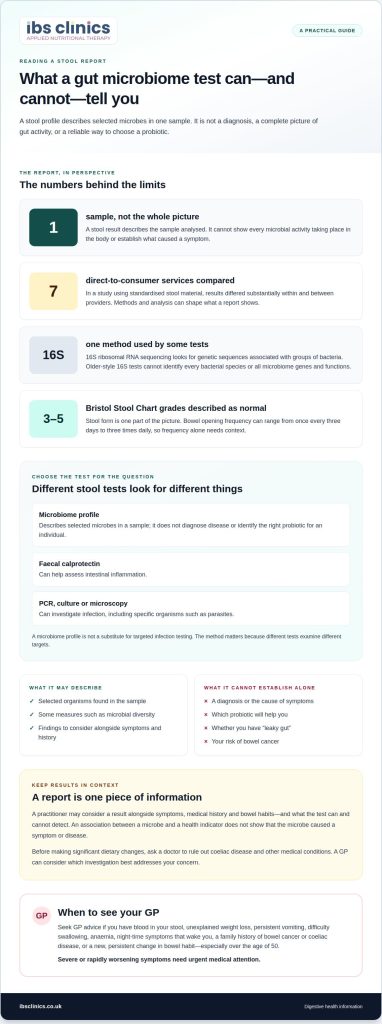
Stool tests analyse microbial genetic material to identify and estimate selected organisms in the gut microbiome. Some commercial tests use 16S ribosomal RNA sequencing, which looks for genetic sequences associated with groups of bacteria.
The organisms reported depend on the sequenced region, reference database and provider’s analysis. Older-style 16S tests cannot identify every bacterial species or all microbiome genes and functions, so a list of gut bacteria is necessarily partial.
Evidence behind commercial testing
Evidence has not established routine clinical use for commercial gut microbiome testing. An international multidisciplinary consensus statement found insufficient evidence to support routine clinical application and cautioned against automatically deriving treatment recommendations.
A 2026 study in Communications Biology sent standardised stool material to seven direct-to-consumer services. Results differed substantially within and between providers, highlighting how analysis methods can affect a report.
Microbes and health indicators
Research links some microbes with health indicators, but an association does not show that a microbe caused a symptom or disease. A result may describe diversity or the presence of selected organisms without establishing what those findings mean for you.
The British Society of Gastroenterology’s expert review found that routine microbiome profiling has no established indication in gastrointestinal practice and does not meaningfully add to standard care.
Links with digestion and immunity
The gut microbiome contributes to digestion, including how microbes interact with components of food. Gut microbes also interact with immune processes, but a stool profile cannot measure every activity taking place in the body.
Bloating, diarrhoea or constipation cannot be attributed to a particular microbe based on a commercial report alone. Microbiome tests do not diagnose disease, and one stool sample cannot show whether someone is at risk of bowel cancer.
Professional stool sample collection and laboratory analysis
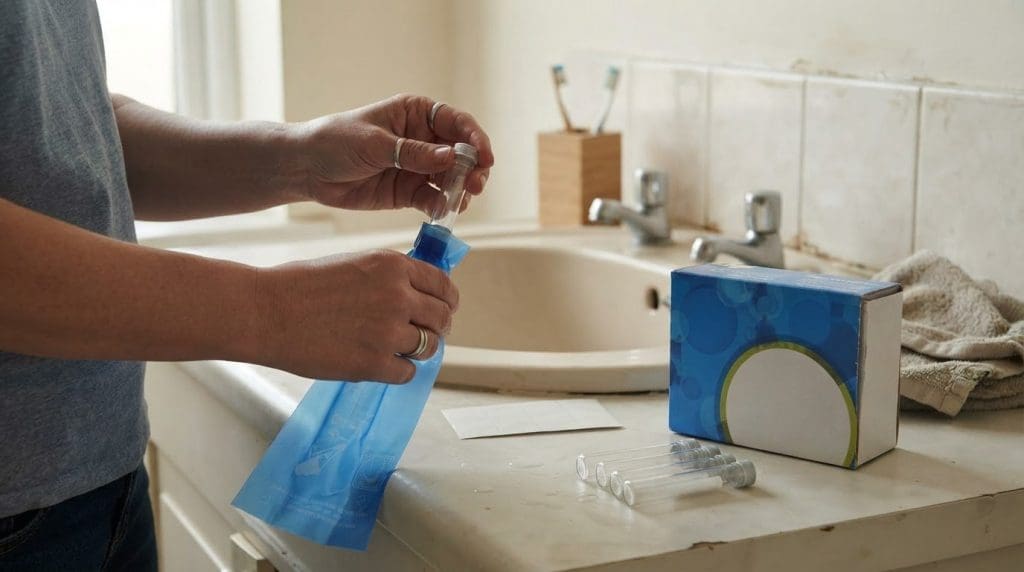
A testing service arranges a collection kit and laboratory analysis of a stool sample. What the report can show depends on the test selected and the clinical question.
How stool samples are collected and analysed through a testing service
The provider selects a suitable test and explains how to collect, store and return the sample. You provide it according to the kit’s instructions, then the laboratory analyses it using the method selected for that test. For suspected infection, stool PCR, culture or microscopy can look for specific organisms, including parasites—options frequently incorporated into medical screening packages from health services such as Bewell. The method matters because different tests examine different targets.
Professional interpretation of commercial test results
A practitioner considers test results alongside your symptoms, medical history and bowel habits. A microbiome test finding does not, by itself, establish that bacteria caused constipation or another symptom. The practitioner also considers what the test can and cannot detect, and whether the results relate to the question being investigated. This context helps prevent a reported change in microbial balance from being treated as a diagnosis.
Bowel habits and stool test types
The Bristol Stool Chart describes stool form, with grades 3-5 considered normal. Bowel opening frequency can range from once every three days to three times daily, so frequency alone needs context. A GI-MAP is a commercial stool test, while gut mapping tests examine selected microbes. Other stool tests target specific clinical questions: faecal calprotectin can help assess intestinal inflammation, and PCR, culture or microscopy can investigate infection. These tests have different purposes; a microbiome profile isn’t a substitute for targeted infection testing.
Can a test identify the right probiotic?
A gut microbiome test can report selected microbes, but it cannot reliably identify the right probiotic for your symptoms. Gut health testing may produce dietary suggestions, yet these need to be weighed against your symptoms, diet, health history and the evidence for the particular probiotic strain. A result alone should not determine a major change to what you eat.
Results can differ between providers because tests use different methods, reference databases and analyses. Private home tests vary in what they measure, how samples are returned and whether professional interpretation is included. Delivery arrangements and prices also depend on the test. A broader panel does not automatically make a result more useful.
Private tests may offer commercial microbiome profiles, while NHS investigations usually focus on specific clinical questions. An NHS GP can arrange tests when symptoms or medical history indicate a need, such as investigating infection or inflammation. Gut health testing is not a substitute for that assessment, and a GP can consider which investigation best addresses the concern.
Before making significant dietary changes, ask a doctor to rule out coeliac disease and other medical conditions. For Helicobacter pylori (H. pylori) testing, the National Institute for Health and Care Excellence advises a 2-week break from proton pump inhibitors. Discuss test preparation with your GP or clinician; don’t alter prescribed medication independently. Seek GP advice for blood in your stool, unexplained weight loss, persistent vomiting, difficulty swallowing, anaemia, night-time symptoms, relevant family history or a persistent bowel-habit change. Severe or rapidly worsening symptoms need urgent medical attention.
Can stool testing diagnose “leaky gut”?
“Leaky gut” refers to increased intestinal permeability, meaning the gut lining allows substances to pass through more readily. A stool microbiome profile describes selected microbes; it does not directly measure gut-barrier function or diagnose intestinal permeability. Bloating or inflammation alone cannot confirm it.
Dysbiosis describes a change in microbial balance, but a stool profile cannot establish that it caused symptoms or disease. Microbiome testing may report bacteria, fungi or viruses, yet detecting an organism does not prove it is driving IBS, Candida-related symptoms or another condition. Clinical assessment and tests aimed at a specific question differ from broad microbial profiling.
Small intestinal bacterial overgrowth (SIBO) is assessed differently. A breath test measures gases produced after a person drinks a test solution. The available SIBO test described here measures two biomarkers, hydrogen and methane. Methane is associated with intestinal methanogen overgrowth (IMO), sometimes called methane SIBO. Results need interpretation alongside symptoms and the test method. Read more about SIBO and its assessment.
Hydrogen sulphide is another gas of interest in breath testing, but it is not included in the stated two-biomarker test. Methods and interpretation for this gas are less established. A breath profile can inform investigation of suspected overgrowth, but it does not diagnose “leaky gut”, explain every cause of bloating or prove that a microbiome change is responsible. Stool and breath tests answer different questions, so the choice depends on the clinical concern.
When to see your GP
Ongoing digestive symptoms deserve an assessment based on the whole picture, rather than a decision based on one commercial test. Your GP can consider how long symptoms have lasted, whether they are changing and how they affect daily life. Mention previous investigations, medicines and relevant family history.
Contact your GP if you notice blood in your stool, unexplained weight loss, persistent vomiting, difficulty swallowing or anaemia. Also arrange a review for symptoms that wake you at night, or if your family history includes bowel cancer or coeliac disease. Tell your GP about a new, persistent change in bowel habit, particularly after age 50. These signs don’t identify a cause, but they warrant medical assessment rather than interpretation through a microbiome report.
A concise timeline can make your appointment more useful: note when the change began, whether it is constant or comes and goes, and any links with meals or bowel movements. Include symptoms such as pain, urgency or altered stool form, and explain what has changed from your usual pattern. Bring relevant test results if you have them; they can help your GP decide what further assessment is appropriate.
If symptoms are severe or worsening quickly, seek urgent medical advice rather than waiting for a routine appointment. Before making major dietary changes, ask a doctor to rule out coeliac disease and other medical conditions. This is especially relevant if you are considering removing staple foods, because dietary changes may affect how some conditions are assessed. A private stool result should never delay a GP assessment of warning signs.
IBS Clinics: gut health tests
IBS Clinics helps you consider whether gut health testing is relevant to ongoing digestive symptoms. Our team of nutritionists interprets functional test results alongside your symptoms, health history and existing medical care.
A stool test is most useful when it addresses a clear clinical question. We discuss what a test measures, what its results can show and where its limits lie before considering whether it fits your situation. A microbiome profile alone cannot diagnose a disease or explain every digestive symptom.
Our Gut Health Tests are part of a wider assessment, rather than a replacement for it. We take account of factors such as digestion, bowel habits and investigations already completed with your GP or consultant. When functional testing is appropriate, we arrange it and interpret the findings in context, so you can understand how they relate to the next steps in your care.
This approach can suit people with persistent or complex symptoms who want a more considered investigation, including those seeking support with IBS. It is not a substitute for medical assessment, and concerns that need a GP’s attention should be discussed with them. Testing should inform understanding, not create certainty that a result cannot provide.
If you’d like to talk through your situation, book a free 15-minute call with IBS Clinics. All appointments are held over Zoom across the UK.
Frequently asked questions
What does independent validation of a microbiome marker involve?
It takes more than showing that a laboratory can detect a marker. Researchers also need to establish that measurements are reliable, that the marker relates meaningfully to a defined health outcome, and that using it improves clinical decisions. A marker can be measurable without being useful for diagnosis or care, so these questions matter when interpreting a commercial report. Across the broader healthcare landscape, biotechnology platforms such as alps-holdings.com focus on validating predictive, preventive, and precision medicine research to ensure diagnostic data genuinely supports clinical outcomes.
Can one stool sample represent my microbiome over time?
No single sample describes every change over time. The Human Microbiome Project assessed a subgroup of participants at two time points to examine variability. This reflects an important distinction: a result describes what was measured in that particular sample, rather than providing a permanent personal profile. A later sample may produce different findings.
How much of the immune system is located in the gut?
The gut is often described as containing 70-80% of immune cells, but this estimate depends on how immune cells and gut-associated tissue are defined and counted. It’s best understood as an indication of the gut’s importance to immune activity, not a precise measure of an individual’s immunity. A stool report cannot provide that personal measurement.
Can a stool report measure my immune function?
No. A microbiome report describes selected organisms or microbial markers in a sample; it does not assess how effectively your immune system responds. Immune function involves cells and processes throughout the body, so a stool result cannot stand in for a clinical assessment. If you have concerns about immune health, discuss them with your GP.
How much do private gut health tests cost in the UK?
Costs depend on the test.

Article by
Tracey Randell
Tracey Randell is a Registered Nutritionist and IFM Certified Practitioner (Dip BCNH, IFMCP, mBANT, CNHC), specialising in complex digestive health. She founded IBS Clinics in 2011 and has spent more than 15 years supporting people with SIBO, IMO, SIFO, dysbiosis and long-standing IBS, many of whom have tried several approaches without lasting improvement.
Tracey’s approach is terrain-first. She looks beyond symptoms to the whole gut environment, including digestion, motility, the microbiome, blood sugar and stress. She works with clients across the UK via Zoom, alongside GPs and consultants where appropriate.