
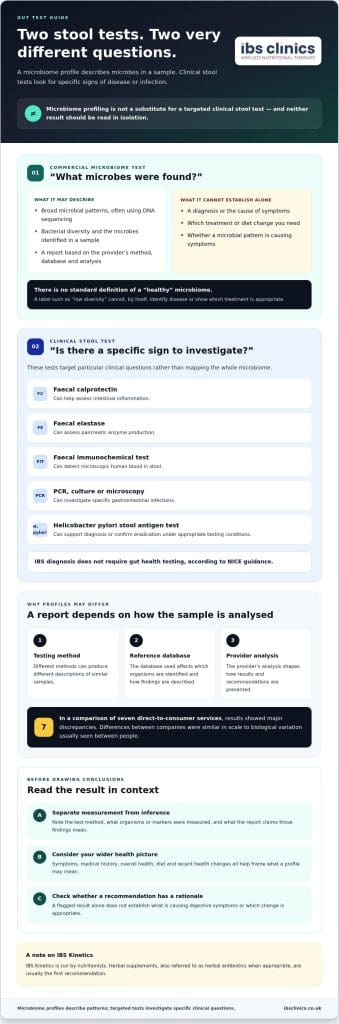
A microbiome test can describe patterns in the microbes found in a stool sample, but it cannot diagnose a condition on its own. In the UK, microbiome testing may use DNA sequencing to identify broad microbial patterns; there is no standard definition of a “healthy” microbiome. NHS stool tests have a different purpose: they look for particular signs of disease or infection.
It’s understandable to seek a clear explanation when digestive symptoms persist. A test result may provide information, but it needs to be considered alongside your symptoms, medical history and overall health. This article explains what microbiome tests measure, how they differ from NHS stool tests, and why a result alone can’t tell you what condition you have or which treatment you need.
Key Takeaways
- Microbiome tests describe microbial patterns; they cannot diagnose a condition on their own.
- NHS stool tests look for specific signs of disease or infection, so their purpose differs from commercial microbiome profiling.
- Interpret results alongside your symptoms, medical history and overall health before considering changes to your diet or supplements.
- Test costs and the information provided can vary, so understand what a result can genuinely help you decide.
Differences between NHS stool tests and functional testing
NHS stool tests investigate specific clinical questions; commercial tests describe microbes found in a sample. For people comparing microbiome testing UK options, the key distinction is what each test is designed to assess.
Evidence for commercial microbiome tests
Commercial microbiome tests often use DNA sequencing to describe microbial patterns, including bacterial diversity. A detailed report may seem definitive, but there’s no standard definition of a healthy microbiome. Current scientific knowledge doesn’t support using commercial microbiota testing alongside lifestyle-change programmes as a basis for care. An international consensus advises against testing without an appropriate clinical indication. This is important when reports offer personalised nutrition guidance: a profile alone doesn’t establish which changes you need.
Test limitations and standardisation
Results depend on the testing method, reference database and analysis used. Different choices can produce different descriptions of similar samples. A 2026 study comparing seven direct-to-consumer services with standardised human stool material found major discrepancies. Variation between companies was similar in scale to biological variation usually seen between people. Since there’s no accepted normal microbiome profile, a microbiome testing UK report labelled “low diversity” cannot, by itself, identify disease or show which treatment is appropriate.
Clinical stool test assessments
Standard clinical tests look for specific signs rather than mapping the whole microbiome. Faecal calprotectin can help assess intestinal inflammation, while faecal elastase can assess pancreatic enzyme production. According to the NHS, a faecal immunochemical test (FIT) can detect microscopic human blood in stool. PCR, culture or microscopy can investigate specific gastrointestinal infections. A Helicobacter pylori stool antigen test can support diagnosis or confirm eradication under appropriate testing conditions. NICE guidance states that diagnosing IBS doesn’t require gut health testing.
UK microbiome test costs
The price can reflect what the sample analysis covers, the technology used, and whether interpretation or nutrition guidance is included. You’re paying for a report, not a clinical diagnosis, so consider what question the test is intended to answer. If you’re concerned about infection, inflammation or bleeding, a targeted clinical stool test addresses a different question from broad microbiome profiling.
Gut microbiome specialist and medical interpretation
A microbiome test produces data, not a diagnosis. Its meaning depends on the method used and your clinical picture. In the UK microbiome testing market, reports can vary in what they measure and how they present findings, so start by understanding the test itself.
Reading reports and disease claims
A report describes findings from a sample; it doesn’t establish that a disease is present. Commercial 16S rRNA sequencing can provide a broad bacterial profile, but the detail depends on the sequenced region, reference database and provider’s analysis. Treat labels and suggested nutrition changes as claims to assess, not conclusions about your health. If you already have a report, note its method, organisms measured and specific claims. A specialist reviewing microbiome testing UK results should distinguish measured findings from what the report infers about symptoms or disease.
UK privacy law applies to personal health information. Read the provider’s privacy notice to understand how sample data and results are stored, accessed, used and retained. Follow the kit instructions when collecting and sending a sample: use the supplied container, avoid contamination, seal it as directed and return it using the stated method.
Results in context
Interpreting results in context means considering them alongside your symptoms, medical history and overall health. The same finding may have different relevance for someone with ongoing bowel symptoms than for someone without them. Your diet, recent health changes and reason for testing also help frame what a profile may mean. Sequencing alone cannot show whether a microbial pattern is causing symptoms, so context helps prevent over-interpreting a result.
A useful review separates what the test measured from what its report recommends. Consider whether each suggestion has a clear rationale and fits your health history and current care. Expert interpretation can help avoid responding too strongly to a finding or overlooking other explanations. If you’re weighing nutrition changes, discussing your gut health concerns can help place a report alongside the wider picture.
Risks of acting on test-based treatment recommendations
A microbiome report may suggest supplements or dietary changes, but a flagged result doesn’t establish what is causing digestive symptoms. Treatment recommendations need a clear rationale, not just a striking result.
Several commercial services offer gut microbiome testing in the UK. Tests and reports vary, so a provider’s name alone doesn’t tell you what the analysis measures or whether its recommendations are clinically useful.
Direct-to-consumer result differences
A 2026 study compared seven direct-to-consumer services using standardised human stool material and found major discrepancies in results. Differences between companies were similar in scale to biological variation usually seen between people. This matters because separate reports may describe the same sample differently. Check what each test measures and how its report explains the findings before treating a result as a guide to action.
Accuracy and clinical relevance
Analytical accuracy concerns how a test measures its targets; clinical relevance asks whether the result helps diagnose or manage disease. Consumer gut tests have limited clinical validation for diagnosing or treating disease. A marker may be measured accurately without explaining symptoms or pointing to a useful treatment. Consider what the marker measures, what the report infers, and whether that interpretation fits your health history.
The GI Effects test may report digestive markers, but a marker isn’t a diagnosis. Herbal supplements, sometimes called “herbal antibiotics”, are often the first recommendation in nutrition-led approaches; a test result alone doesn’t mean you should start taking them. Poorly conducted testing can lead to unnecessary supplements, adding cost and complexity without addressing your concern. Separate measured findings from treatment advice, and look for a clear reason behind each recommendation.
Personalised follow-up should explain how recommendations relate to your symptoms and wider health. If symptoms persist or worsen, share the report with a clinician involved in your care. Any further assessment should relate to your symptoms and clinical question, not simply a flagged microbiome result.
How much do microbiome tests cost in the UK?
There isn’t one price for every microbiome test in the UK. The total depends on what the provider analyses and includes in the report. A test focused on sequencing may differ in scope from one that also examines other stool markers or provides personalised interpretation. Before comparing prices, identify the test’s stated purpose and the information its report is designed to provide.
Look at the full package, not just the headline cost. Check whether the price covers the sample kit, laboratory analysis, delivery and written results. Then find out whether an explanation of the findings or follow-up advice is included or priced separately. For example, two tests may both describe bacteria but offer different levels of analysis and interpretation. Those differences affect what you receive, not whether the result can diagnose a condition.
For a tailored test, the price depends on the case and is provided after a quote request; factors include the sample, analysis and interpretation required. A quote clarifies the planned scope before you decide. It’s also useful to ask what clinical question the test is intended to address. If your symptoms suggest a specific concern, broad microbiome profiling may not answer it as directly as a targeted clinical stool test.
Consider the possible next costs as well. A report may prompt discussion of nutrition changes or supplements, but recommendations should have a clear rationale and relate to your symptoms. Avoid treating extra testing or products as automatic requirements. If you’re considering a test and want to understand what it covers, explore gut health testing as part of a considered approach to your digestive health.
IBS Clinics: Free 15 Minute Intro chat / ask your questions
IBS Clinics is run by nutritionists who can help you consider microbiome results alongside your symptoms and health history. If a report has left you unsure what to do next, the Free 15 Minute Intro chat gives you space to ask questions and discuss whether gut health tests or IBS care may be relevant.
Support can also include special diets, with choices tailored to your digestive symptoms rather than based on a report in isolation. A microbiome result cannot diagnose a condition on its own, so the focus is on understanding what the findings may contribute to the wider picture.
If you’d like to talk through your questions, contact IBS Clinics to book your consultation.
Choose your next step with care
Before arranging microbiome testing in the UK, decide what you want the result to help you understand. Is your main concern persistent discomfort, a change in bowel habits, or uncertainty about a report you already have? A clear question can keep testing and follow-up focused on what matters to you, rather than collecting more data without a purpose.
IBS Clinics offers Gut Health Tests and IBS care, with a Free 15 Minute Intro chat to ask questions and explore what support may suit your situation. You can use that conversation to discuss your concerns and what you hope to learn, without treating a test result as the whole picture.
If you’re ready to talk through a possible next step, contact IBS Clinics about your gut health. Take the process at a pace that feels manageable, and keep your symptoms and priorities at the centre of the conversation.
Frequently Asked Questions
What is the gut microbiome?
The gut microbiome is the community of microbes living in the digestive tract, including bacteria, fungi and other microorganisms. These microbes interact with one another and with the body, while their mix differs between individuals. A stool sample captures some of this community, but it doesn’t represent every organism throughout the digestive system. A microbiome profile is therefore a partial view, not a complete picture of gut function.
Are gut microbiome tests worth doing?
Microbiome tests may help describe microbial patterns, but whether testing is worthwhile depends on the question you want answered. For example, someone seeking an explanation for persistent symptoms may need clinical assessment rather than a broad profile alone. Before paying for a test, consider whether its findings could change a decision you’re making. If the report offers recommendations, look for a clear explanation of how each one follows from the results.
Can a microbiome result tell me exactly what to eat?
No, a microbiome result can’t prescribe an exact personal diet. A report might highlight microbes or suggest food changes, but that doesn’t establish which foods cause your symptoms or suit your nutritional needs. For example, removing several food groups based only on a profile could make your diet unnecessarily restrictive. A more useful approach considers your symptoms, usual diet, preferences and nutritional balance before making changes.
Can a test identify the right probiotic?
A microbiome test can’t reliably select a probiotic that will work for you. Finding a particular bacterium doesn’t prove that taking the same species will address a symptom. Probiotic effects can depend on the specific strain and reason for use, so broad labels such as “beneficial bacteria” aren’t enough to guide a choice. Discuss the purpose and evidence for a product before adding it to your routine.
Can stool testing diagnose “leaky gut”?
A routine stool microbiome profile cannot, by itself, diagnose “leaky gut”. The phrase is commonly used to describe increased intestinal permeability, but a list of microbes in stool doesn’t directly measure the gut barrier. If you have ongoing symptoms, describe their pattern, duration and effect on daily life during clinical assessment. This helps frame which explanations or investigations are relevant, rather than relying on a report label.
Gut Microbiome Test UK: What Can Gut Mapping Really Tell You?
Gut mapping can show which microbial patterns a particular test detects in your stool sample. It may describe the organisms included in its analysis and how the provider classifies them. It cannot show the full activity of the gut or prove that a detected pattern causes a symptom. To interpret a map practically, separate measured findings from interpretations, then consider what questions it can and cannot answer.