
What if the next step in IBS care isn’t another food to cut out, but a clearer understanding of which support fits your needs? When symptoms continue despite general diet or lifestyle advice, it can be hard to know whether to return to your GP, seek nutrition support or consider testing. A useful plan should give each step a clear purpose, rather than adding restrictions or supplements without a reason.
Medical care and nutrition support have different, complementary roles. Your GP can assess symptoms and consider whether further investigation or treatment is needed. A nutritionist can explore how food, lifestyle and digestive health relate to your experience. Nutrition support should not replace medical assessment or treatment.
This article explains what IBS care may involve and how different forms of support can fit together. You’ll learn what to consider when weighing up dietary changes, supplements and gut health tests, and how to build a manageable pathway around your needs. The aim is to help you identify a practical next step without unrealistic promises or unnecessary pressure.
Key Takeaways
- IBS care can bring medical guidance, self-management and nutrition support together, with each playing a different role.
- Know when a GP’s assessment matters and how personalised nutrition may complement, rather than replace, medical care.
- Look for recommendations grounded in your symptoms, health history, lifestyle and priorities, with a clear reason for each step.
- Testing and dietary changes aren’t automatic requirements. Consider them in context and review whether they remain useful.
- IBS Clinics’ remote consultations with registered nutritionists offer personalised support, from an introductory discussion to tailored recommendations.
What does IBS care involve when symptoms keep returning?
Symptoms may settle, then return, or change just as you begin to understand what helps. That uncertainty can be tiring, but a flare-up by itself doesn’t show what is causing symptoms or mean you’ve done anything wrong.
IBS care is ongoing support to understand and manage symptoms, rather than a single fix or a plan that must work for everyone. It may bring together medical guidance, practical self-management and nutrition support. Each has a distinct role: a GP can assess your health and advise on medical concerns, while everyday strategies and personalised nutrition may help you explore ways to manage symptoms in the context of your life. A general overview of irritable bowel syndrome describes its symptoms and the range of approaches that may be considered.
A nutrition consultation can review eating patterns, lifestyle and digestive history, then discuss tailored dietary or supplement recommendations where appropriate. It doesn’t diagnose or rule out medical conditions, provide emergency care or guarantee that symptoms will resolve. Testing isn’t automatically needed either. Any decision about tests or significant dietary changes should have a clear purpose and be considered alongside your medical care.
Why IBS care may need to change over time
Symptoms and practical needs vary between people, and one person’s circumstances can change too. Work patterns, stress, routines, food access or a new symptom pattern may affect what feels manageable. Advice that once suited you may need reviewing. Adding more restrictions by default isn’t the only option.
Regular reflection can help keep a plan relevant. Note when symptoms occur, what has changed in your routine, which strategies feel sustainable and what questions you want to raise. These notes aren’t a way to diagnose yourself; they can make conversations with a GP or nutritionist more focused. Review whether a recommendation is practical and still matches your priorities before making further changes.
When should IBS symptoms be discussed with a GP?
Speak with your GP about symptoms that are new, changing or concerning, even if you’ve previously been told you have IBS. A clinician can assess whether medical review or investigation is appropriate. Nutrition support may complement this care, but it shouldn’t take the place of an assessment when one is needed.
For severe or acute symptoms, seek urgent medical help rather than waiting for a nutrition appointment. If you’re unsure how urgently to act, contact an NHS medical service for guidance. You don’t need to work out the cause before asking for help. The aim is to have concerns assessed appropriately, while nutrition support remains focused on manageable ways to support your wellbeing alongside medical care.
How do medical care, self-management and nutrition support differ?
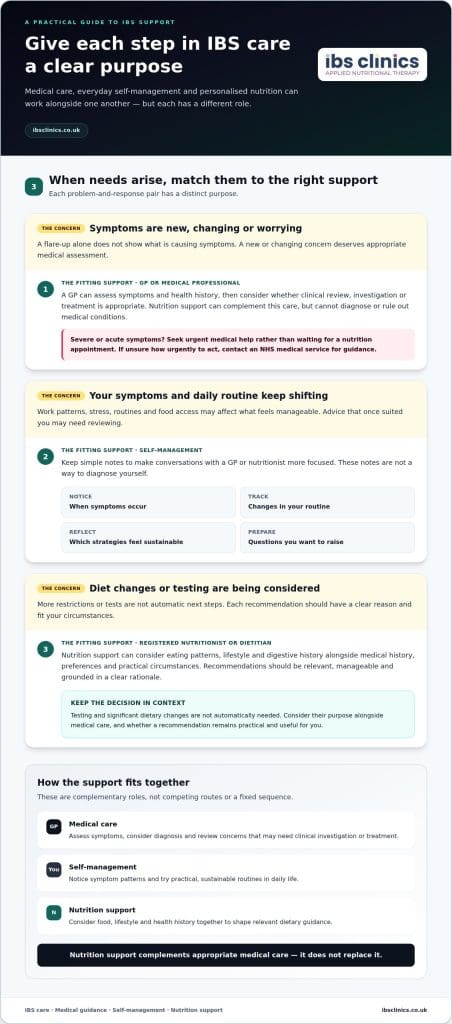
These forms of support can work alongside one another, but they don’t have the same purpose. Medical care assesses health concerns and advises on clinical next steps. Self-management involves noticing patterns and using practical strategies in daily life. Personalised nutrition support explores how food and lifestyle relate to your experience, helping you consider relevant, manageable changes.
| Type of support | Who provides it | Typical focus |
|---|---|---|
| Medical care | GP or other medical professional | Assessing symptoms, considering diagnosis and reviewing concerns that may need clinical investigation or treatment. |
| Self-management | You, with guidance where helpful | Noticing symptom patterns and trying practical, sustainable routines in daily life. |
| Nutrition support | Registered nutritionist or dietitian | Considering food, lifestyle and health history together to shape relevant dietary guidance. |
The table is a guide, not a set of separate lanes. For example, you might discuss a new concern with your GP, keep a simple record of how symptoms affect daily routines, and seek nutrition input to review whether your eating pattern is practical and varied. In a joined-up approach to IBS care, nutrition support complements appropriate medical care rather than taking its place.
What is the role of a GP or medical professional in IBS care?
A GP can assess symptoms, discuss your health history and decide whether further clinical review or investigation is appropriate. This matters because digestive symptoms can have different explanations, and a nutrition consultation cannot diagnose or rule out medical conditions. Keep your GP involved if symptoms change, persist or worry you, and share relevant updates about support or dietary changes you’re considering. For severe or acute symptoms, seek urgent medical help rather than waiting for a routine nutrition appointment.
What can personalised nutrition support add?
A nutrition professional can look beyond a list of foods and consider your symptoms alongside your medical history, routines, preferences and practical circumstances. A useful recommendation should have a clear rationale and fit your day-to-day life. For instance, advice might focus on reviewing meal patterns or making one manageable adjustment, rather than removing several food groups at once. Restriction isn’t automatically needed; any dietary approach should be practical and nutritionally balanced, with changes considered in context.
Nutrition support may also help you make sense of information you’ve gathered, such as a food diary or relevant test results, without treating either as a diagnosis. IBS Clinics’ remote consultations with registered nutritionists give you a chance to discuss your digestive health, history and priorities. Use the free 15-minute introductory chat to ask about nutrition support and the clinic’s approach.
How can you judge whether IBS care is genuinely personalised?
Personalised support should start with your experience, not a pre-set list of foods to avoid or tests to buy. A careful practitioner will want to understand your symptoms, how they affect daily life and what you hope to change. Good IBS care also leaves room to adapt: what seems useful at the beginning may need reviewing as your needs become clearer.
What should a thoughtful nutrition approach take into account?
A useful review may consider bowel patterns, how symptoms have changed over time, existing diagnoses, previous advice and everyday routines. Work hours, food preferences, cooking facilities and budget all affect whether a recommendation is realistic. Your priorities matter too. You may want to feel more confident eating away from home, or find a routine that fits busy mornings.
Dietary guidance should consider nutritional adequacy as well as symptom goals. If a change is suggested, you should understand why it may be relevant, how to put it into practice and when to review whether it’s helping. If gut health testing is considered, it should have a clear purpose and be interpreted alongside your history and symptoms. A result on its own isn’t a complete explanation of your health.
How can you avoid unnecessary restriction or testing?
Be cautious of advice that starts by removing several foods without first considering your usual diet and circumstances. Restrictive approaches aren’t automatically appropriate, and they shouldn’t be treated as permanent by default. A test is a tool, not a standalone answer. Before agreeing to either, understand what question the intervention is intended to address and how the findings could inform next steps.
Look for a clear rationale, not a promise that a particular food, supplement or test will solve everything. Individual responses vary, and no plan can guarantee symptom relief. A sound approach makes space to discuss possible benefits, practical demands and reasons to pause or adjust. It should also revisit recommendations rather than adding more changes whenever symptoms fluctuate.
Use this checklist when considering a nutrition support step:
- Whole picture: Will the practitioner consider my symptoms, history, diagnoses, routine and priorities?
- Clear reasoning: Can they explain why a suggested change or test may be relevant to me?
- Practical fit: Can I manage the recommendation alongside work, family life, preferences and nutritional needs?
- Review: Is there a way to reflect on how the plan is working and adapt it if needed?
- Appropriate scope: Will nutrition support sit alongside medical care, with clinical concerns directed to my GP?
You don’t need every answer before seeking support. A helpful first conversation can clarify what you’ve already tried, what matters most and whether a proposed next step feels proportionate. If the explanation is clear and the plan respects your priorities, you’re better placed to decide whether it suits you.
What can you expect from a structured IBS care pathway?
A clear pathway gives each step a purpose, without assuming that everyone needs the same tests or dietary changes. It helps you understand what is being considered, why it may be relevant and how the next decision will be made. The process is collaborative, and appropriate medical care remains part of the picture.
A nutrition support pathway may move through these stages:
- Discuss your concerns. Explain what support you’re seeking and how digestive symptoms affect daily life. This helps establish what you’d like the process to address.
- Review the wider picture. Consider digestive health, medical history, lifestyle and existing guidance together, rather than viewing one food or symptom in isolation.
- Agree priorities. Decide which questions or manageable changes to focus on first. A useful plan should have a clear rationale and fit your circumstances.
- Review progress. Reflect on symptoms, how practical the recommendations feel and whether the plan still matches your priorities. This can guide adjustments or further discussion.
The stages don’t have to follow a rigid timetable. A review may show that the priority is to discuss a concern with your GP, try a modest dietary adjustment or make sense of information already available. A structured approach to IBS care doesn’t promise a particular outcome; it helps you make decisions thoughtfully and adapt them as your needs become clearer.
How are gut health tests considered within IBS care?
Testing isn’t an automatic step for everyone with IBS. It should be considered when there’s a clear reason to think the result could inform decisions about your care. The purpose, limitations and possible next steps should be explained, so a test isn’t treated as a shortcut to a complete answer.
If testing is appropriate, professional interpretation can place results alongside your symptoms, history and other relevant information. A result shouldn’t be viewed in isolation or used to replace medical assessment. At IBS Clinics, gut health test results are professionally interpreted and considered in the wider context of your digestive health.
How may recommendations be reviewed and adapted?
Follow-up is a chance to discuss what you’ve noticed and how recommendations fit into ordinary life. Consider whether a dietary change feels sustainable, whether it has affected the variety of foods you eat, and whether your original priorities still apply. Symptoms can fluctuate, so one difficult day or a short-term change doesn’t necessarily tell the whole story.
Dietary guidance may be adjusted with balanced nourishment and practicality in mind. Supplement recommendations, where relevant, should be tailored to the individual and discussed as guidance, not a guaranteed treatment. To talk through a possible pathway, book a free 15-minute introductory chat with IBS Clinics.
How does IBS Clinics provide personalised care in the UK?
IBS Clinics provides remote nutrition consultations with registered nutritionists for people across the UK. The focus is on understanding your experience in context, rather than assuming the same food changes or tests will suit everyone. Nutrition support can sit alongside appropriate GP or medical care; it doesn’t replace assessment of symptoms or medical concerns.
A consultation may include a broad review of digestive health, medical history, lifestyle and individual priorities. This can help put recurring symptoms and previous advice into a wider picture. You can discuss what you’ve already tried, what feels difficult to manage and what you hope to explore. The aim is to consider possible next steps together, without promising a diagnosis or a particular result.
Where appropriate, support may include tailored dietary or supplement recommendations. Gut health testing may also be considered when it has a clear purpose, with results professionally interpreted in context. Neither testing nor dietary restriction is an automatic starting point. The care pathway should reflect your circumstances and remain compatible with any medical guidance you’re receiving.
What is the purpose of the free introductory chat?
The free 15-minute introductory chat is an opportunity to talk about your symptoms, ask questions and discuss possible care pathways. You might want to understand how nutrition support could fit alongside your existing care, or whether testing could be relevant to the questions you’re trying to answer. The conversation lets you explore the clinic’s approach; it isn’t a diagnostic appointment or a promise of symptom relief.
You don’t need to arrive with a complete explanation of what’s happening. It may be enough to describe what has been troubling you and what kind of support you’re considering. If symptoms are new, changing or concerning, keep your GP involved. Urgent or severe symptoms need appropriate medical attention rather than waiting for a nutrition conversation.
How can you take a considered next step with IBS care?
Before choosing a next step, consider what matters most to you. Perhaps you want to review eating patterns without adding unnecessary restrictions, make sense of previous test results, or find support that takes daily routines into account. A clear priority can keep the conversation focused while leaving room to discuss what’s realistic for you.
Personalised nutrition support offers a structured way to explore food, lifestyle and digestive health, with recommendations shaped around your history and priorities. It should remain complementary to appropriate medical care, not a substitute for it. If you’d like to discuss whether this approach feels suitable, arrange a free 15-minute introductory chat with IBS Clinics.
Choose a next step that feels manageable
You don’t have to work out the whole picture before seeking support. A useful next step might be naming the question you’d most like help with, such as how to approach meals with more confidence or what kind of nutrition guidance could fit your routine. That gives the conversation a starting point without committing you to a particular plan.
Good IBS care leaves room for your priorities, questions and changing needs. If you’re weighing up personalised nutrition support, an introductory conversation can help you explore the approach at your own pace. Take time to consider what you hear and how it fits alongside your existing medical care.
Arrange a free 15-minute introductory chat with IBS Clinics to discuss your symptoms and possible care pathways. It’s a clear first step towards understanding the options and deciding what feels right for you.
Frequently Asked Questions
Is IBS care the same as getting an IBS diagnosis?
No. A nutrition consultation isn’t a medical diagnosis. If you haven’t been assessed for your symptoms, speak with your GP, who can decide whether clinical assessment or investigation is appropriate. Nutrition support may help you explore eating patterns and daily routines, but it shouldn’t be used to confirm that symptoms are IBS or rule out another condition. Discuss medical questions with your GP.
Can I have nutrition support for IBS whilst seeing my GP?
Yes. Nutrition support can sit alongside GP care, and sharing relevant information can help keep your support coordinated. Tell your nutritionist about diagnoses, investigations or dietary guidance you’ve received, and update your GP about significant changes or concerns. Don’t stop or change prescribed treatment based on nutrition advice alone. Your GP is the right person to discuss medical treatment and new symptoms.
Does IBS care always include gut health testing?
No. Testing isn’t required automatically, and whether it’s worth considering depends on your circumstances and the question you’re trying to answer. Before agreeing to a test, understand its purpose and how the result could inform your next steps. A test result needs professional interpretation in context; it shouldn’t be treated as a diagnosis or a complete explanation of symptoms on its own.
Will IBS care mean following a low-FODMAP diet?
No. A low-FODMAP diet is one possible dietary approach, not a standard requirement for everyone with IBS. If it’s considered suitable, it should be approached thoughtfully, with attention to nutritional balance and whether it fits your needs. The aim isn’t to avoid as many foods as possible. A personalised plan should explain why a dietary change is being suggested and how it will be reviewed.
Can I access IBS nutrition care remotely anywhere in the UK?
IBS Clinics provides remote nutrition consultations for people across the UK, so support isn’t limited to those who can attend in person. Registered nutritionists can consider your digestive health alongside your medical history and lifestyle. Remote care may suit you if travel is difficult or you prefer to speak from home. Discuss medical concerns with your GP.
Can IBS be cured through personalised nutrition care?
Personalised nutrition care can’t promise to cure IBS or guarantee that symptoms will resolve. Its role is to help you consider relevant dietary and lifestyle support, with recommendations shaped around your circumstances. Progress may look different from person to person. You might focus on making meals feel more manageable or understanding which changes are practical to maintain. Keep your GP involved in ongoing symptoms and medical concerns.