

What if a reaction isn’t a pass-or-fail verdict on a food, but a clue about your personal tolerance? If you’re wondering how to reintroduce foods after elimination diet, it’s understandable to feel cautious, especially when symptoms have been difficult to manage. Reintroduction is a structured way to gather information, not a reason to label every uncertain food off-limits for good.
The aim is to learn what you can tolerate, in what amounts and under what circumstances, while gradually bringing more variety back into your diet. A clear plan helps you focus on one change at a time and notice patterns without jumping to conclusions about a single symptom.
This guide explains how to choose a food to test, introduce it in a measured way and keep a useful record of what happens. You’ll also learn how to interpret possible reactions, when to pause and why a response doesn’t always mean permanent restriction. Known severe food allergies are different from intolerances and shouldn’t be tested at home. If a general plan doesn’t fit your symptoms or dietary protocol, individualised nutrition support can help consider your health history, lifestyle and food patterns together.
Key Takeaways
- Learn how to reintroduce foods after an elimination diet with a measured challenge plan that suits the reason for your restrictions.
- Choose a time when your symptoms and routine are reasonably steady, then test one food at a time and record what you notice.
- Understand why low-FODMAP challenges may follow a different pattern from other clinician-guided elimination diets.
- Consider portion size, timing, stress, sleep and illness before interpreting a symptom as a lasting intolerance.
- Find out when personalised nutrition support may help, particularly if you have several restrictions or unclear symptom patterns.
Why reintroducing foods after an elimination diet matters
Removing foods may help you investigate a suspected trigger, follow a therapeutic diet or make sense of digestive symptoms. The reason for the restriction matters because there isn’t one reintroduction method for every elimination diet. A low-FODMAP plan, for example, examines groups of fermentable carbohydrates, whilst another clinician-guided diet may focus on particular foods or a different health question. The general idea is to remove and then reintroduce foods in a considered way, as outlined in What is an Elimination Diet?
It’s understandable to worry that symptoms will return. However, symptoms during a challenge don’t automatically prove that a food is the cause or that you must avoid it permanently. Reintroduction helps you gather clues about your own response. It can explore tolerance, but it cannot diagnose an allergy or disease.
What does food reintroduction involve?
You select a food or food group and test it while keeping the rest of your diet as consistent as practical. This makes changes easier to spot, although it can’t remove every influence on symptoms. The aim isn’t a perfect result. It’s to build a useful picture of your tolerance: a food may seem well tolerated, the portion may matter, or the result may be unclear.
For instance, you might notice no meaningful change, or you might experience symptoms after a larger serving but not a smaller one. The result can also be difficult to interpret if several foods or routines changed at once. In that case, record the uncertainty and review the pattern rather than making a lasting restriction based on one episode. Never test a food at home if you have a history of a severe or anaphylactic reaction to it.
Why avoid unnecessary long-term restriction?
Keeping foods out of your diet for longer than needed can narrow your choice of meals and make eating with friends, family or at work more complicated. A varied diet can also make it easier to include a broad range of nutrients, although restriction doesn’t automatically mean that your diet is nutritionally inadequate. The aim isn’t to bring back every food regardless of your response. It’s to avoid rules that aren’t supported by what you learn.
This is especially relevant if you’re managing IBS. A low-FODMAP diet is intended to move beyond its initial restriction towards personalised choices, rather than treating every high-FODMAP food as permanently off-limits. Understanding irritable bowel syndrome (IBS) can also help put food-related symptoms in context, since symptoms and triggers may vary from person to person.
If you’re considering how to reintroduce foods after elimination diet, start by identifying why the foods were removed. That context helps you choose what to challenge and interpret the result without assuming that one response tells the whole story.
How to reintroduce foods after an elimination diet, step by step
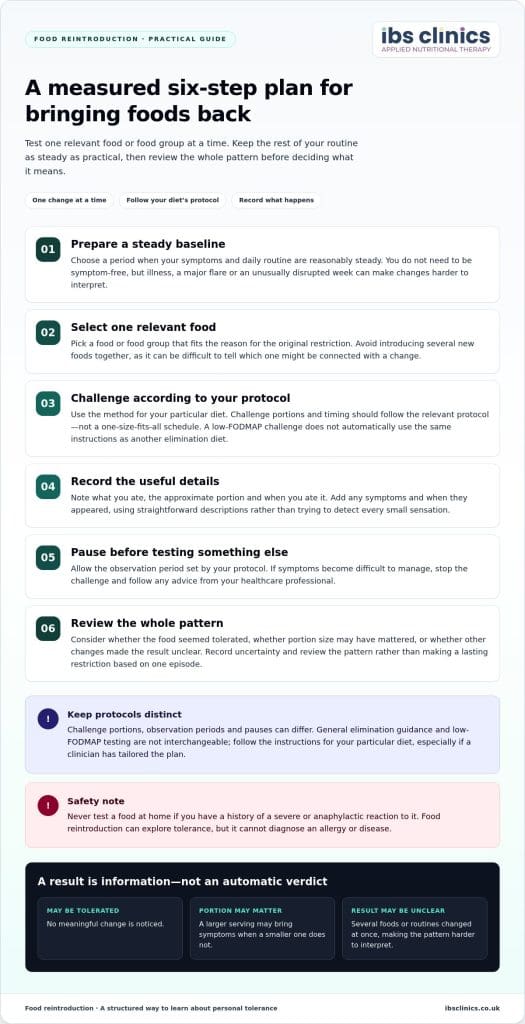
A simple plan can make a food challenge feel less daunting and your observations more useful. Begin with the reason for the restriction: a condition-specific or prescribed diet may have its own method, so generic timings won’t suit everyone.
- Prepare. Choose a period when your symptoms and daily routine are reasonably steady. You don’t need to be symptom-free, but illness, a major flare or an unusually disrupted week can make changes harder to interpret.
- Select. Pick one food or food group that’s relevant to the original restriction. Avoid introducing several new foods together, as it can be difficult to tell which one might be connected with a change.
- Challenge. Test the selected food according to the method for your diet. Challenge portions and timing should follow the relevant protocol, not a one-size-fits-all schedule. A low-FODMAP challenge, for example, doesn’t automatically follow the same instructions as another elimination diet.
- Record. Note what you ate, the approximate portion and when you ate it. Add any symptoms and when they appeared, using straightforward descriptions rather than trying to detect every small sensation.
- Pause. Allow the observation period set by your protocol before testing something else. If symptoms become difficult to manage, stop the challenge and follow any advice from your healthcare professional.
- Review. Look at the whole pattern before deciding what to do next. Consider whether the food seemed tolerated, whether the portion may have mattered, or whether other changes made the result unclear.
Prepare a steady baseline and choose a challenge
Keep other meals and routines as consistent as practical during a challenge. You don’t need to eat an identical menu or put life on hold; the goal is simply to limit extra changes that could cloud your observations. Choose a food that fits the reason you began the diet and keep the test focused on that food or group. If your diet is prescribed or linked to a health condition, follow its clinician-led protocol rather than adapting general instructions.
Protocols may set different challenge portions, observation periods and pauses. General elimination guidance may recommend leaving several days between new foods, whilst a low-FODMAP plan uses its own approach to testing FODMAP groups. These timings aren’t interchangeable. Follow the instructions for your particular diet, especially if a clinician has tailored the plan to your circumstances.
Record the challenge without over-monitoring
A brief diary is usually more helpful than constant checking. Write down the food, approximate portion, time eaten, any symptoms and relevant context, such as an unusually stressful day or poor sleep. Describe what happened in everyday terms, including when it began and how noticeable it felt. Where practical, avoid changing other foods, supplements or routines at the same time.
A registered nutritionist can tailor the process if a general plan doesn’t fit your symptoms or dietary protocol. Personalised nutrition guidance can take your food patterns, health history and lifestyle into account.
How low-FODMAP and other elimination diet challenges differ
The right challenge depends on what you stopped eating and why. Low-FODMAP reintroduction explores tolerance to particular fermentable carbohydrate groups in people following that approach. Other elimination diets may remove specific foods for a different symptom-led or clinician-directed reason, so the foods tested and the way results are interpreted can differ.
| Consideration | Low-FODMAP challenges | Other clinician-guided elimination diets |
|---|---|---|
| What is tested | Individual FODMAP groups, rather than all high-FODMAP foods as one category. | Foods or groups selected to match the reason for the diet and the agreed clinical plan. |
| Background diet | Challenges are assessed against a low-FODMAP background, as set out in the relevant protocol. | The plan may use a different baseline or testing method, depending on the original restriction. |
| How findings are used | Results help inform personal tolerance to specific FODMAP groups and portions. | Interpretation depends on the health question and may need to be reviewed with the clinician guiding the diet. |
What is distinctive about low-FODMAP reintroduction?
Rather than challenging several FODMAPs together, this approach tests groups separately whilst keeping the rest of the diet low in FODMAPs. Different foods can represent different groups, so a mixed meal may not show which group is relevant. Monash University’s guidance is specific to FODMAPs, not a universal protocol for every elimination diet. Use current trusted guidance for the precise challenge food, portion, duration and pauses.
Low-FODMAP challenges commonly follow a structured, group-by-group process, with portions and observation days set by the protocol. Don’t assume that a serving schedule for one food applies to another, or that a result for one FODMAP group predicts your response to all of them. The aim is to understand your individual pattern, not label a whole category based on an unrelated challenge.
When does another elimination diet need a different plan?
A symptom-led trial may explore whether a particular food seems associated with symptoms. Allergy management and medically prescribed exclusions involve different clinical considerations. If you suspect a food allergy, have had a severe reaction or are following a medically supervised restriction, don’t use a self-directed challenge. Seek clinical advice about whether reintroduction is appropriate and how it should be managed.
The original reason for avoiding foods should guide what you test, the order of challenges and the level of supervision. A plan intended to investigate digestive symptoms, for example, shouldn’t automatically borrow a FODMAP food list or timetable. Understanding how to reintroduce foods after elimination diet means matching the method to the diet’s purpose, rather than searching for one sequence that suits everyone. If the reason or protocol is unclear, a registered nutritionist can consider your symptoms, health history and current diet together.
How to interpret symptoms and decide what to try next
A symptom during a food challenge can feel worrying, particularly if it resembles something you’ve experienced before. Symptoms can fluctuate for many reasons, and one episode doesn’t establish a lasting intolerance. Look carefully at what happened without dismissing your experience or drawing a firm conclusion too quickly.
A recorded association is a useful clue, not proof that a food caused the symptom. Portion size and timing may matter, as can stress, sleep, illness and changes to your usual routine. These factors don’t prove an alternative cause either. They provide context for reviewing the challenge alongside your overall pattern.
What if symptoms return during a challenge?
Make a note of what you ate, how much, when symptoms began and how they felt. Follow the observation and pause instructions for your particular protocol before deciding what the result means. If symptoms are marked, concerning or difficult to manage, stop or pause the challenge rather than pushing through to complete it. There isn’t one symptom score or threshold that suits every person and every diet.
Seek clinical advice if symptoms are severe, persistent or worrying, especially if you’re unsure whether it’s safe to continue. Don’t use a food challenge to investigate a suspected allergy or repeat a food associated with a serious reaction. If you’re following a medically supervised diet, ask the clinician overseeing it for guidance on what to do next.
What if the result is unclear or changes over time?
An unclear response is still useful information: the challenge may not have given you a confident answer. Perhaps your symptoms were already fluctuating, your routine changed, or the reaction was mild and short-lived. Record that uncertainty. It’s more balanced than treating the food as a confirmed trigger and excluding it indefinitely.
Responses can also vary between occasions. If one challenge seems to cause symptoms but another does not, consider the amount eaten and the surrounding circumstances before deciding what the pattern suggests. A repeat challenge may help clarify an uncertain result, but only if it fits your diet’s protocol and is appropriate for your circumstances. Don’t repeat a challenge linked to a severe reaction without clinical advice.
Use the evidence you have so far to decide whether to continue with another food, pause to review or discuss the findings with a registered nutritionist. Look for a pattern across relevant challenges rather than letting one observation shape your whole diet. The process of how to reintroduce foods after elimination diet should leave room for uncertainty and careful review, not just stricter rules.
If mixed or changing responses make it difficult to decide what to try next, a personalised nutrition consultation can help you review your symptoms, health history, lifestyle and food pattern with a registered nutritionist.
When personalised nutrition support can help with food reintroduction
Some people find a general reintroduction plan straightforward. Others are unsure what to test, how to interpret mixed results or whether their current diet includes enough variety. Support from a registered nutritionist may be useful if you’re avoiding several foods, struggling to meet your nutritional needs or finding that symptoms don’t follow a clear pattern.
A tailored review can help put your food challenges into context. It won’t guarantee that symptoms will resolve or diagnose a disease, but it can help you make considered decisions about what to try, what to record and when to seek further clinical advice. The aim is practical guidance that respects your experience without adding restrictions without good reason.
What can an individualised review consider?
A registered nutritionist can explore why the elimination diet began, which foods you currently avoid and how your symptoms have changed over time. They can consider food records alongside your health history, lifestyle, daily routine and wider health context. This can help distinguish a consistent pattern from an isolated response, while also considering whether your current food choices are meeting your nutritional needs.
Where relevant, gut health testing may form part of the wider picture, with results interpreted alongside your symptoms and history. Functional wellness practices such as 5280 Restorative Medicine often take this comprehensive view, examining digestive balance in the context of broader metabolic health and daily stressors. Testing isn’t necessary for everyone and shouldn’t be treated as a stand-alone answer. An individual review brings different strands of information together rather than relying on one food challenge to explain everything.
A manageable next step when reintroduction feels difficult
You don’t need a perfect diary to have a useful conversation. Bring a concise record of the foods you’ve challenged, approximate portions, symptom timing and any notable changes in routine. If you haven’t kept one, a brief account of what you remember is still a helpful place to begin. It can make it easier to discuss where your plan feels uncertain and what a sensible next step might be.
IBS Clinics provides remote, personalised nutrition consultations with registered nutritionists across the UK. If you’re unsure how to reintroduce foods after elimination diet, individual support can adapt a general approach to your symptoms, health history, lifestyle and current diet. You can start with a free 15-minute introductory chat to discuss your questions.
Take your next step at a pace that feels right
Food reintroduction doesn’t need to be a test you either pass or fail. Think of it as a gradual way to make more informed choices, with room to pause, review and adjust as you learn. If you’re still unsure how to reintroduce foods after elimination diet, you don’t have to work through every uncertain result alone.
IBS Clinics offers remote consultations with registered nutritionists, where guidance can take account of your symptoms, health history, lifestyle and current diet. The aim is to help you consider a manageable way forward, not promise that every symptom will disappear or that one food explains everything.
To talk through your questions and options, arrange a free 15-minute introductory chat with IBS Clinics.
Frequently Asked Questions
Can I reintroduce foods after avoiding them for several months?
Yes, foods can often be considered again after several months, but the time spent avoiding them doesn’t show whether they remain unsuitable. First revisit why they were removed and whether the diet was clinician-guided. If exclusions have accumulated, avoid restarting several at once. A registered nutritionist can help prioritise a manageable sequence and consider whether your current diet is nutritionally adequate. Don’t test foods linked to a severe reaction or diagnosed allergy at home.
Is food reintroduction the same as allergy testing?
No. A food challenge as part of an elimination diet is not an allergy test and cannot confirm or rule out an allergy. Allergy assessment is a separate clinical process. Digestive symptoms after eating a food don’t, by themselves, establish an allergy either. If you’re concerned about a possible allergic reaction, discuss it with a healthcare professional instead of using a home challenge to investigate it.
How long should I wait between food challenges?
The interval depends on the diet’s protocol. For general elimination diets, guidance often recommends waiting at least three to five days before introducing another food, so reactions are easier to distinguish. Low-FODMAP challenges may use a different structure, such as testing a group over three days with a pause between challenges. If you’re unsure how to reintroduce foods after elimination diet, follow the instructions for your specific plan rather than mixing schedules.
Can stress or poor sleep affect how I respond to a food challenge?
Stress and poor sleep may coincide with changes in how you feel, so note them alongside the food and symptoms in your record. They don’t prove that a food caused a reaction, nor do they prove that stress or sleep explains it. If symptoms occur after a disrupted night, for example, record both details and consider the overall pattern before making a lasting change to your diet.
What should I do if I am following more than one elimination diet?
Pause before combining challenge plans, as the diets may restrict overlapping foods for different reasons and use different methods. Write down each diet’s purpose, the foods excluded and who recommended it. A registered nutritionist can review the combined restrictions, identify where guidance may conflict and help you consider a suitable next step. Don’t add challenges from one protocol to another without considering how they fit your individual circumstances.
Can I reintroduce foods if I have a diagnosed food allergy?
Don’t reintroduce a food linked to a diagnosed allergy on your own. Allergy-related challenges are different from investigating digestive tolerance and may require clinical supervision. Continue to follow the advice given by the healthcare professional managing your allergy, even if you’ve avoided the food for a long time or your symptoms have changed. If you’re uncertain whether a food is covered by your allergy plan, seek clinical advice before eating it.
Do I need a nutritionist to reintroduce foods after an elimination diet?
Not everyone needs one, but individual guidance can help if you’re avoiding several foods, unsure how to interpret results or concerned about getting enough variety. A registered nutritionist can review your food record alongside your symptoms and health history, then help adapt your plan. This may be particularly useful when a general protocol doesn’t fit the reason for your restrictions or feels difficult to manage in everyday life.
