
What if the most useful gut test isn’t the one with the longest list of markers? If you’re considering a comprehensive stool analysis test UK after persistent bloating, altered bowel habits or other digestive discomfort, it’s understandable to hope a detailed report will make things clearer. But a broad panel isn’t automatically a better answer, and results alone may not explain your symptoms.
Before choosing a test, pin down what you want it to investigate. Then check whether the panel measures relevant markers, how it analyses them and what support is available to interpret the report. This guide explains the potential scope and limits of stool analysis, so you can judge whether testing fits the question you want to explore.
We’ll look at how tests differ, why commercial microbiome findings need careful interpretation, and how results may sit alongside your symptoms, medical history and wider care plan. At IBS Clinics, registered nutritionists provide professional analysis of gut health test findings and consider them in that broader context, rather than treating a stool test as a stand-alone diagnosis.
Key Takeaways
- Start with a clear question about your symptoms when deciding whether a comprehensive stool analysis test UK is relevant to your next step.
- Compare the markers and methods each panel uses. A longer list doesn’t automatically make a test more useful.
- Follow the kit’s collection, storage and return instructions carefully, as procedures can vary between tests.
- Read results in context. Findings may offer clues, but they don’t guarantee an explanation for digestive symptoms.
- Professional interpretation can help place findings alongside your symptoms, medical history and lifestyle when considering a personalised plan.
What does a comprehensive stool analysis test in the UK assess?
A comprehensive stool analysis examines a stool sample for selected features that may help investigate digestive or gut health questions. Depending on the panel, it might look for particular microbes, assess aspects of digestion or measure markers associated with intestinal inflammation. It can provide information to consider alongside symptoms and health history, but it doesn’t diagnose a condition or guarantee an explanation for symptoms.
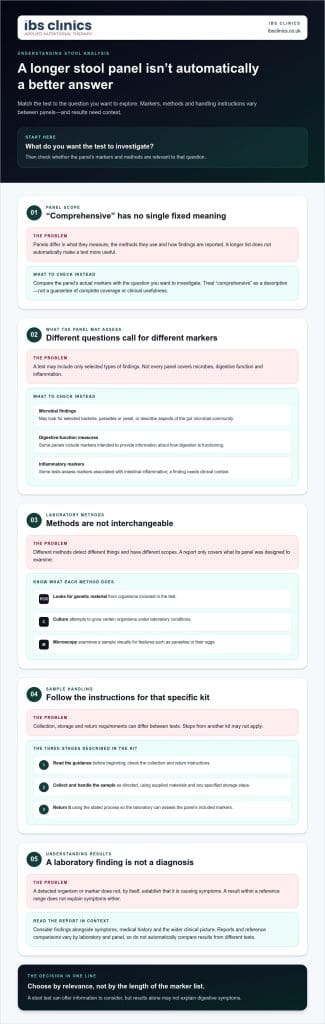
A stool analysis panel is a set of laboratory tests on a stool sample, selected to investigate particular microbes or aspects of digestive function and gut health. The word “comprehensive” doesn’t describe one fixed UK-wide standard. Panels vary in what they measure, the methods they use and how they report results. A longer list isn’t automatically a more useful one.
Which types of information might a stool panel include?
Group possible findings by the question they relate to. A panel may include one or more of these categories, but no single list applies to every test:
- Microbial findings: Tests may look for selected bacteria, parasites or yeast, or describe aspects of the gut microbial community. The organisms examined depend on the panel.
- Digestive-function measures: Some panels include markers intended to provide information about how digestion is functioning. These findings are different from identifying a microbe.
- Inflammatory markers: Some tests assess markers associated with intestinal inflammation. A result needs clinical context and shouldn’t be treated as proof of a particular condition on its own.
The method matters, too. PCR looks for genetic material from organisms included in the test. Culture attempts to grow certain organisms under laboratory conditions, while microscopy involves examining a sample visually for features such as parasites or their eggs. These methods aren’t interchangeable: they detect different things and have different scopes. The general Stool test overview describes the range of microbial, chemical and microscopic analyses used in stool testing.
What does ‘comprehensive’ mean when comparing tests?
Treat “comprehensive” as a description, not a guarantee of complete coverage or clinical usefulness. One panel might focus on selected pathogens; another may combine microbial testing with digestive or inflammatory measures. Reports also present findings in different ways, which can affect how straightforward they are to interpret.
Start with the question you want to investigate, then compare the markers and methods listed for each panel against it. If you’re concerned about infection, the panel’s microbial scope may be most relevant. If your question relates to digestion, check whether the panel assesses digestive function. A result outside a reference range, or a microbe detected in a sample, doesn’t establish that it is causing symptoms. Its significance depends on the person’s symptoms, medical history and wider clinical picture.
How stool analysis samples and results are processed
What happens after you decide to test? Stool analysis generally involves collecting a sample at home, sending it for laboratory analysis and receiving a report. The exact process depends on the test and laboratory. For a comprehensive stool analysis test UK, use the kit’s instructions as your guide: collection, storage and return requirements can differ, so don’t assume that one test’s steps apply to another.
Careful handling matters. If you collect or store a sample in a way that doesn’t follow the instructions, the laboratory may not be able to assess it as intended. Read the guidance before collecting the sample, and follow the stated steps rather than relying on advice for a different test.
What happens from sample collection to laboratory analysis?
The test kit explains how to collect and prepare the sample, what to do with it afterwards and how to return it. Follow those directions closely, including any instructions about storage. Avoid improvising or relying on general advice from another test, as requirements can vary with the panel and its laboratory methods.
- Read the kit guidance. Check the full collection and return instructions before beginning.
- Collect and handle the sample as directed. Use the supplied materials and follow any specified storage steps.
- Return it using the stated process. The laboratory then assesses the markers included in that particular panel.
Laboratory analysis may use methods such as PCR, culture or microscopy to assess selected organisms, or other methods to measure panel-specific markers. Not every test uses the same combination. The report covers what the panel was designed to examine, rather than every aspect of gut health.
How should you read a stool analysis report?
A report presents laboratory findings, often with reference comparisons or explanatory notes. The format and ranges depend on the laboratory and panel, so don’t automatically compare a result with one from a different test. Read the report in full, including notes about the method and what the findings can and can’t show.
A laboratory finding is a measurement, not a clinical diagnosis. A reported organism or marker may be worth discussing, but its significance for you depends on the wider picture. A result alone can’t establish that a finding is causing symptoms, and a finding within a reference range doesn’t necessarily explain persistent discomfort.
For a more grounded interpretation, consider the report alongside:
- the symptoms you’re experiencing and when they occur
- your medical history and any relevant clinical assessment
- the specific markers and methods included in the test
Professional interpretation can help connect these details and clarify what the results may mean for your next steps, without treating the test as a stand-alone answer. IBS Clinics’ registered nutritionists provide professional analysis and clinical interpretation of gut health test findings. You can also arrange a 15-minute introductory chat to discuss how testing might fit into personalised support.
Is a comprehensive stool analysis test useful for digestive symptoms?
A stool test can offer information relevant to a specific question, but a detailed report doesn’t guarantee an explanation for bloating, bowel changes or other digestive symptoms. A comprehensive stool analysis test UK may report selected organisms or other markers. Whether those findings help guide next steps depends on what was tested and how the results fit your individual circumstances.
This distinction matters because finding a microbe is not the same as proving it caused a symptom. Microbes may be associated with health or digestive function, but an association in a test result doesn’t establish individual causation. A result that attracts attention may not lead to a clear or appropriate action, either. Testing is one possible part of a broader investigation, not a promise to uncover the cause of IBS or another condition.
What can a stool test tell you, and what can it not establish?
A stool test can report information about the markers its panel measures. Its usefulness depends on whether those markers relate to a defined clinical or nutrition question, and whether there’s a sensible way to interpret them in context. Commercial microbiome tests may describe aspects of the organisms detected, but a profile alone doesn’t show which findings are responsible for symptoms or what intervention will help.
Functional stool testing and standard medical investigations can serve different purposes. In the UK, NHS stool tests may be used for specific clinical questions, such as looking for hidden blood with a Faecal Immunochemical Test (FIT) or investigating particular infections. Private comprehensive panels may assess a wider selection of microbial or digestive markers, but that breadth doesn’t make them a substitute for assessment through a GP or the NHS.
When might a broader medical assessment come first?
If symptoms are new, changing, persistent or worrying you, speak with your GP or seek appropriate NHS advice rather than relying on a commercial test to decide what they mean. A clinician can consider your symptoms and history, decide whether a medical investigation is appropriate and advise on the right route. This is particularly important if your health is deteriorating or you feel you need timely medical attention.
Nutrition-focused testing has a different role. It may help inform personalised nutrition support when there’s a clear reason to investigate particular gut health markers, but it doesn’t replace medical assessment where that’s needed. Nor should it delay care while you wait for a report. If you’ve already taken a test, share relevant findings with your healthcare professional rather than interpreting them in isolation.
Before testing, write down the question you hope it will help explore. Are you looking for information about a particular type of organism, or considering a broader nutrition investigation after other care? If the panel can’t reasonably address that question, its detailed report may add information without clarifying your next step. A careful discussion of symptoms, medical history and the test’s purpose can help determine whether testing is appropriate and how any findings might fit into wider care.
How to compare comprehensive stool analysis tests in the UK
Choosing a panel is easier when you begin with the question you want it to help explore, rather than the word “comprehensive”. A test may list many markers but still miss information relevant to your circumstances. Compare what it measures, how it does so and what support is available to make sense of the findings.
A practical checklist for comparing test panels
Use this framework to compare the scope of each option and the care around it. It can help you judge whether a panel is relevant without assuming that more markers mean better answers.
| What to compare | What to consider |
|---|---|
| Clinical question | What are you hoping the test will investigate, and is that question within the panel’s stated scope? |
| Markers | Which organisms, digestive-function measures or inflammatory markers are included? Are they relevant to your question? |
| Methods | Does the panel use PCR, culture, microscopy or another method, and what does that method assess? |
| Interpretation | Is professional help available to explain the findings in relation to your symptoms and medical history? |
| Follow-up | How might results inform next steps, and is the test considered as part of wider support? |
A panel with a shorter, relevant marker list may be more useful than a broader one that doesn’t address your main question. Look for a clear explanation of what results can and can’t show, not just a long inventory of measurements. If you’re investigating ongoing IBS-type symptoms, wider IBS diagnosis and support context can also help distinguish a test’s role from other aspects of assessment and care.
Questions to consider before deciding on a test
Before choosing a comprehensive stool analysis test UK, consider whether it could add relevant information to what you already know about your health. A useful discussion connects the proposed markers to a clear question, rather than treating testing as an automatic next step.
- What specific question is this panel intended to help investigate?
- How would its findings be considered alongside my symptoms and medical history?
- What might change in my care plan as a result, and what if the findings are unclear?
- Is professional interpretation available to help make sense of the report?
Laboratory analysis is only one part of the process. Professional interpretation can place results alongside symptoms, history and wider health, then consider whether they inform an individualised nutrition strategy. It can’t guarantee a cause or a particular outcome, but it may make the findings easier to discuss and use thoughtfully.
If you’re unsure which question to start with, book a free 15-minute introductory chat with IBS Clinics to discuss your questions and possible care pathways.
How IBS Clinics uses stool testing within personalised gut health support
A stool test can add information, but it’s only one part of understanding someone’s gut health. At IBS Clinics, registered nutritionists provide remote personalised consultations and professional interpretation of gut health test findings. The aim is to consider what a report may contribute to an individual investigation, not to treat a result as a diagnosis or promise that testing will explain symptoms.
Putting test findings into a whole-person context
A report is more meaningful when viewed alongside the person’s experience. The nutritionist considers findings in relation to symptoms, medical history, lifestyle and wider health, rather than interpreting a marker in isolation. For example, the relevance of a result may depend on the symptoms that led someone to test and other details in their health history.
Lifestyle and wider physiological context also matter when considering nutrition support. Eating patterns, day-to-day routines and the broader picture of health can all inform how findings are understood and what options may be worth discussing. People with similar symptoms may have different histories and needs, so the same test or nutrition strategy won’t suit everyone.
Testing isn’t a required step for every person. It may form part of a broader investigation when there’s a clear question it could help explore, but care can also begin by understanding symptoms and circumstances. A comprehensive stool analysis test UK should be considered in relation to the person’s needs and wider care, rather than chosen simply because it offers a detailed report.
What to expect from a first conversation about testing
The free 15-minute introductory chat offers space to discuss your questions, outline what you’re experiencing and talk about possible care pathways. You can raise what you hope testing might clarify, or ask how test findings may be considered alongside your health history. It’s a chance to explore the topic without assuming that a test is necessarily the right next step.
If testing is part of a wider support plan, professional interpretation can help connect the report with the rest of your health picture. Findings may inform an individualised nutrition strategy, while the approach remains tailored to you. The test itself doesn’t guarantee a specific explanation or outcome, and any recommendations need to make sense in context.
If you’re weighing up testing, you don’t need to have every question settled before talking it through. Arrange a free 15-minute introductory chat to discuss your questions and possible next steps with IBS Clinics.
Choose your next step with clarity
You don’t need to decide on a test simply because symptoms have been difficult to explain. Start by naming the question you want help exploring, then consider whether testing could add relevant information to your existing health picture. That can make the decision more manageable, even if you’re still unsure.
If you’re considering a comprehensive stool analysis test UK, IBS Clinics’ registered nutritionists provide remote personalised care, including professional analysis and clinical interpretation of gut health test findings. A conversation can help you talk through your questions and consider possible next steps without assuming a test is automatically right for you.
IBS Clinics was founded in 2011 by Tracey Randell. Arrange a free 15-minute introductory chat to discuss your questions and possible next steps with IBS Clinics.
Frequently Asked Questions
What does a comprehensive stool analysis test look for?
It looks for the markers included in that particular panel, which may involve selected microbes, digestive-function measures or inflammation-related markers. Tests described as a “comprehensive stool analysis test UK” can cover quite different panels, so check the marker list rather than relying on the name. For example, a test focused on detecting pathogens may answer a different question from one that also includes digestive measures.
Is a comprehensive stool analysis test accurate?
Accuracy depends on what the test is designed to detect and the laboratory method used. A result can only speak to the markers measured, and a negative finding doesn’t rule out every possible cause of symptoms. If a result seems unexpected or doesn’t fit how you feel, discuss it with a qualified professional rather than treating it as definitive. Ask what the test can detect and what its limitations are.
Can a stool analysis test diagnose IBS?
No. A stool analysis test doesn’t diagnose IBS. A clinician assesses symptoms and health history, and may consider tests to investigate other possible explanations. A commercial panel’s microbiome findings aren’t a substitute for that assessment. If you’ve received a report, you can share it with your GP or nutritionist for discussion, especially if your symptoms are changing or you’re uncertain what the results mean.
How do I prepare for a comprehensive stool test?
Follow the instructions supplied with your specific test, as collection and handling requirements can differ. Read them before collecting a sample, and check whether the guidance says anything about medicines, supplements or changes to your usual routine. Don’t stop prescribed medicines or make major dietary changes unless a healthcare professional advises you to. If any instruction is unclear, resolve that before taking the sample.
What happens if my stool test results are abnormal?
An abnormal result means a measured marker differs from the laboratory’s stated reference or reporting criteria. It doesn’t automatically mean you have a condition or need treatment. Read the laboratory’s explanation, then discuss the finding with the professional interpreting your test or your GP. They can consider it alongside symptoms, medical history and any other assessment, and help decide whether follow-up is appropriate.
Are commercial gut microbiome tests recommended in the UK?
Commercial microbiome tests aren’t a replacement for NHS investigations used for specific clinical purposes, and microbiome mapping isn’t currently part of routine NHS diagnosis or treatment. Their usefulness depends on the question being explored and whether the findings can guide a sensible next step. Before buying one, consider how results will be interpreted and whether they’ll add anything to your existing care or assessment.
Should I have a stool test before speaking to a nutritionist?
No, you don’t need to arrange a test before speaking to a nutritionist. An initial discussion can help clarify your symptoms, what you hope to learn and whether testing might be relevant. Bring any existing test reports or a brief note of your symptoms, when they occur and changes you’ve noticed. That information can make it easier to discuss suitable options without assuming a test is needed.