
Could an online appointment still feel personal when digestive symptoms have a long history? If you’re searching for a nutritionist for IBS near you in the UK, remote consultations can make specialist support accessible wherever you live. An individual assessment can explore your symptoms, medical history and eating patterns to clarify what support may suit you.
It’s understandable to want more than another general list of foods to avoid, especially if you’ve already tried different approaches or felt your concerns were brushed aside. An individual assessment can help make sense of your symptoms and identify practical next steps. Consider the practitioner’s digestive health experience, how they tailor dietary guidance and when they recommend involving your GP.
Key Takeaways
- Look for a Registered Nutritionist with relevant digestive health experience, and understand why coeliac disease should be considered before major dietary changes.
- Learn how a supported low FODMAP approach is structured, including why foods are reintroduced rather than excluded indefinitely.
- See how symptoms, medical history and day-to-day needs can shape individual nutrition support delivered online across the UK.
- Recognise symptoms that call for medical advice, and find out how IBS Clinics can discuss your situation and support nutrition needs, including for people on GLP1’s.
One-to-one online consultations with a specialist digestive health nutritionist
Online appointments make specialist digestive health support accessible across the UK, without travelling to a clinic. If you’re looking for a nutritionist for IBS near you in the UK, remote care can be a practical option. In a one-to-one consultation, a nutritionist can review your symptoms, eating patterns, medical history and previous dietary changes. Recurring bloating after meals, for example, raises different questions from sudden diarrhoea.
When choosing a practitioner, look beyond the title. Check their nutrition qualifications, professional registration and experience with digestive problems such as irritable bowel syndrome (IBS). A Registered Nutritionist may have credentials such as registration with the Complementary and Natural Healthcare Council (CNHC) or membership of the British Association for Nutrition and Lifestyle Medicine (BANT). A dietitian is a different professional title, so clarify the practitioner’s training and approach. If you’re searching for a registered nutritionist for IBS near you in the UK, look for relevant experience and clear explanations.
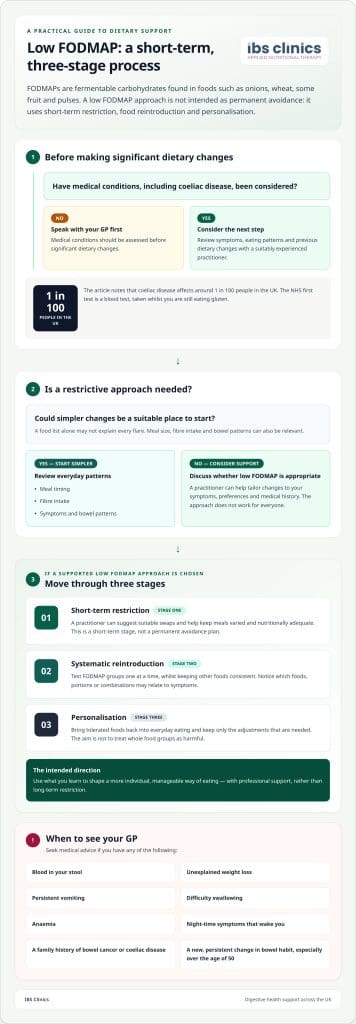
Coeliac disease affects around 1 in 100 people in the UK, according to the NHS. Its symptoms can overlap with IBS, so medical conditions should be assessed before significant dietary changes. The NHS says the first test for coeliac disease is a blood test while you’re still eating gluten. An individual assessment should consider medical investigations, not just a list of foods.
In an online appointment, you can discuss your concerns, ask how recommendations are tailored and find out what follow-up involves. A specialist should explain their reasoning, recognise when GP input is needed and avoid making restrictive eating the default. These details help you assess whether their experience suits your needs.
What are the common causes of gut symptoms?
IBS symptoms can have several contributing factors, not just one food. FODMAPs are fermentable carbohydrates found in foods such as onions, wheat, some fruit and pulses. For some people, poor absorption or fermentation can contribute to gas and discomfort. Meal size, fibre intake and bowel patterns also matter, so a food list alone cannot explain every flare.
A nutritionist with specialist IBS experience can review your eating patterns and symptom history before suggesting changes. The low FODMAP diet is a structured approach, not a permanent avoidance plan. It has three stages: short-term restriction, systematic reintroduction and personalisation based on observed tolerance.
During restriction, a practitioner can suggest suitable swaps and help keep meals varied and nutritionally adequate. During reintroduction, FODMAP groups are tested one at a time while other foods remain consistent. This can help identify which foods, portions or combinations may relate to symptoms, rather than treating whole food groups as harmful.
Personalisation brings tolerated foods back into everyday eating and retains only necessary adjustments. This matters because long-term restriction can narrow food choices and make balanced eating harder. A practitioner can tailor support to symptoms, preferences and medical history. The British Dietetic Association provides information about professional credentials; relevant IBS and low FODMAP experience also matters. The special diets used for IBS should be appropriate to the person, rather than applied as a one-size-fits-all plan.
Dietary support for IBS can start with simpler changes rather than a restrictive plan. A practitioner may consider meal timing or fibre intake, or support a low FODMAP diet when appropriate. This structured approach may help some people manage symptoms, but it does not work for everyone. It involves short-term restriction followed by systematic reintroduction and personalisation, and is best followed with professional support. The aim is to identify foods, portions or combinations that may relate to symptoms, then bring tolerated foods back into everyday eating.
Symptoms and suitability for personalised support
Personalised nutrition support may suit adults whose IBS symptoms continue to affect meals, work or social plans. Examples include urgency after breakfast, bloating that changes through the day, or constipation alternating with loose stools. If you’re looking for a nutritionist for IBS near you in the UK, consider whether the practitioner will explore these patterns alongside your medical history and previous approaches, rather than treating one symptom in isolation.
Ongoing support can help you review recommendations as your needs change. Follow-up appointments can explore what has improved, what remains difficult and whether the plan feels manageable. For example, a food change that eases one symptom but makes meals harder to plan is worth discussing. Collaborative review gives you space to ask questions and consider practical next steps.
A tailored written report can summarise the assessment, priorities and recommendations. Email support can help clarify how to apply them between appointments, such as adapting a meal when an ingredient is unavailable. When comparing options for a nutritionist for IBS near you in the UK, ask how follow-up works, what the report covers and how questions are handled.
Online appointments make it possible to discuss digestive symptoms with a nutrition professional from anywhere in the UK. Support is most useful when communication is clear and recommendations fit your routine, food preferences and wider care. A practitioner with relevant professional membership and digestive health experience should explain how their approach relates to your symptoms. Our guide to digestive symptoms describes patterns you may wish to discuss in an assessment.
When to see your GP
IBS-like symptoms can overlap with other conditions, so some changes need medical assessment before nutrition support. Contact your GP if you notice blood in your stool, unexplained weight loss, persistent vomiting or difficulty swallowing. These symptoms do not establish a diagnosis, but they should not be assumed to be IBS.
Seek medical advice about anaemia, symptoms that wake you at night, or a new, persistent change in bowel habit. A change deserves particular attention, especially if you’re over 50. Explain whether it involves frequency, consistency or urgency, and when you first noticed it.
Tell your GP if you have a family history of bowel cancer or coeliac disease. If you know which relative was affected and whether they had a confirmed diagnosis, share those details. Your GP can consider them alongside your symptoms and wider medical history when deciding whether assessment or investigation is needed.
Discuss ongoing or changing symptoms with a doctor before making significant dietary changes. It can help to note when symptoms occur, how they affect eating or sleep, and any recent changes in bowel habits. Bring a list of medicines and supplements if relevant. If symptoms feel urgent or severe, seek medical help promptly rather than waiting for a nutrition appointment.
Medical history and individual assessment
For irritable bowel syndrome (IBS), an assessment should start with your story, not a standard food list. A nutrition professional may ask when symptoms began, how often they occur and whether your bowel habits alternate. For example, urgency after meals differs from constipation that has gradually worsened. These details help shape relevant questions and clarify what nutrition support may address.
Your medical history adds context. Previous investigations, coeliac testing, gut infections, surgery, prescribed medicines and supplements can all inform the discussion. Family history, sleep, stress, work patterns and regular meal timing may also matter. A clinician considers these factors together. A symptom diary or previous test results can help clarify the timeline, but cannot replace medical assessment.
Clinical knowledge matters when symptoms overlap. Bloating after meals may relate to eating patterns, but persistent diarrhoea, unexplained weight loss or blood in the stool need GP review, not dietary assumptions. The practitioner should distinguish what falls within nutrition support and what needs medical input. This helps avoid treating every digestive complaint as IBS.
After assessment, recommendations can be prioritised and explained, with clear links to your history. If fibre changes are considered, the practitioner can discuss type, amount and tolerance rather than removing all high-fibre foods. Follow-up can review how your symptoms and eating respond, then adapt the plan. A clear consultation process makes the reasoning transparent.
Medication can be part of the conversation without becoming its only focus. In the UK, a GP may prescribe stronger medicine for IBS if pharmacy medicines are not helping. That possibility is conditional: the relevant point is whether pharmacy medicines are helping, rather than an assumption that stronger medicine is needed. The wording also matters because “may prescribe” describes an option, not a guaranteed outcome. It does not say that stronger medicine will be prescribed in every case, or that it is the sole response to consider. Keeping this possibility in view can help place medication within an individual assessment, alongside the nutrition support being discussed. A clear account of whether pharmacy medicines have helped can make the question easier to raise with a GP. The prescribing decision remains with the GP, and the option depends on the condition described in the fact: pharmacy medicines are not helping.
IBS Clinics: Nutrition support for people on GLP1’s
IBS Clinics is a UK practice run by nutritionists, offering individual digestive health support for people with persistent IBS concerns. We also provide nutrition support for people on GLP1’s, where changes in appetite, meal patterns or digestive symptoms can make eating feel more complicated. The focus is practical: understand what has changed, review your food intake and consider support that fits your circumstances.
For IBS care, an assessment can bring symptoms, medical history, previous investigations and eating patterns into one picture. Gut health tests may be discussed when relevant, but testing does not replace GP assessment. Significant dietary changes should follow medical review, including consideration of coeliac disease. If symptoms are new, severe or concerning, discuss them with your GP before focusing on nutrition.
If you’re unsure whether this approach suits you, the free 15-minute introductory chat gives you space to ask questions and explain your priorities. Appointments are held over Zoom for people across the UK, so location need not determine access to this support. We can talk through whether individual nutrition support fits your current needs, without assuming one plan suits everyone.
To talk through your situation, book a free 15-minute introductory chat with IBS Clinics.
Frequently asked questions
Is this service right for you?
Personalised nutrition support may suit you if ongoing digestive symptoms affect everyday eating and you want individual guidance alongside appropriate medical care. You don’t need a perfect food diary or a clear explanation of your symptoms before getting started. Be ready to discuss your routine and priorities, and to take a collaborative approach rather than expect a guaranteed or instant result.

Article by
Tracey Randell
Tracey Randell is a Registered Nutritionist and IFM Certified Practitioner (Dip BCNH, IFMCP, mBANT, CNHC), specialising in complex digestive health. She founded IBS Clinics in 2011 and has spent more than 15 years supporting people with SIBO, IMO, SIFO, dysbiosis and long-standing IBS, many of whom have tried several approaches without lasting improvement.
Tracey’s approach is terrain-first. She looks beyond symptoms to the whole gut environment, including digestion, motility, the microbiome, blood sugar and stress. She works with clients across the UK via Zoom, alongside GPs and consultants where appropriate.