
Could the same digestive symptoms point to different patterns from one day to the next? If pain, bloating or changes in your bowel habits feel unpredictable, it’s understandable to wonder whether they could be IBS symptoms, or whether something else might explain them. IBS doesn’t look the same for everyone, and a symptom list can’t confirm a diagnosis.
Paying attention to how symptoms behave over time can give you a clearer starting point. Note whether they come and go, change after a bowel movement, or involve constipation, diarrhoea or both. You don’t need to diagnose yourself: a record of what happens can help you explain your experience to a healthcare professional.
In this article, we’ll look at common IBS symptom patterns, how they can vary and which changes deserve prompt medical advice. We’ll also cover what to record, including when symptoms occur and what else changes. If you’re considering nutrition support, a personalised approach can take your symptoms, health history and lifestyle into account alongside appropriate medical guidance.
Key Takeaways
- Notice how abdominal pain, bloating and bowel changes appear together, without treating a symptom checklist as a diagnosis.
- Learn why IBS symptoms can differ between people and shift between constipation, diarrhoea or both over time.
- Consider possible triggers as clues, not proof, and understand how gut-brain communication may influence symptoms without implying they’re “all in your head”.
- Find out what symptom details to record and when to seek medical advice rather than self-diagnosing.
- Explore how personalised nutrition support can be a next conversation alongside appropriate medical assessment.
IBS Symptoms: Which Digestive Changes Are Most Common?
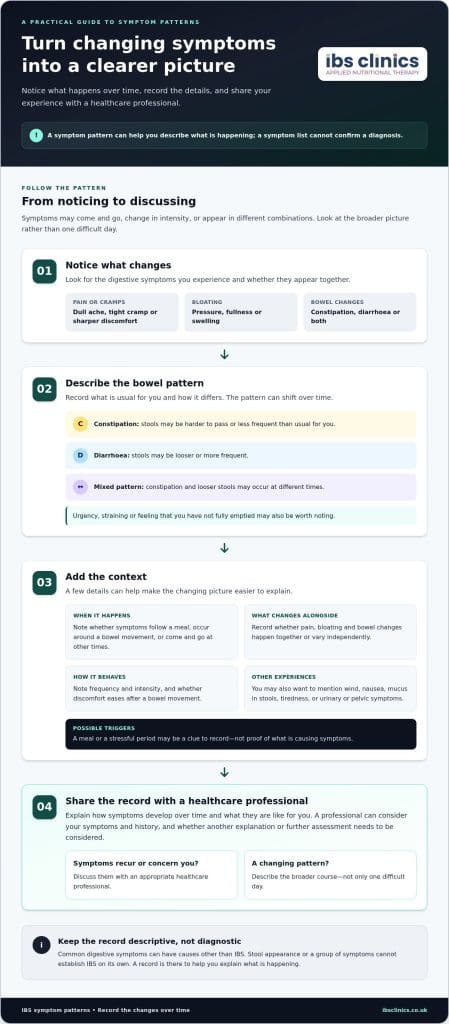
Abdominal discomfort can interrupt a meal, a journey or a night’s sleep. Unpredictable bowel changes can also make it harder to plan your day. IBS symptoms commonly include abdominal pain or cramps, bloating and changes in bowel habits. These symptoms may appear together, but their combination and intensity differ from person to person.
Common IBS symptoms form a pattern of digestive changes, but they don’t confirm a diagnosis on their own. A healthcare professional considers how symptoms develop over time and whether another explanation needs investigation. For a general overview, Irritable bowel syndrome (IBS) is a functional gastrointestinal disorder that commonly involves abdominal pain, bloating and changes in bowel movements. Recognising familiar features can help you describe what’s happening, but it can’t establish the cause.
Abdominal pain, cramps and bloating
Pain may feel like a dull ache, a tight cramp or sharper discomfort. Some people notice it around the time they open their bowels; others find it follows a meal. It may ease after a bowel movement for some, but that isn’t a universal pattern. Location and intensity can vary, so one person’s experience won’t necessarily match another’s.
Bloating can feel like pressure, fullness or swelling in the abdomen. It may come and go, sometimes alongside pain or changes in bowel habits. The sensation doesn’t always mean your abdomen looks visibly larger, and visible swelling isn’t needed for bloating to feel uncomfortable. Note when it happens and what else is going on, such as a change in bowel habits or discomfort after eating.
Changes in bowel habits
Bowel changes may involve constipation, diarrhoea or a shift between the two. With constipation, stools may be harder to pass or less frequent than is usual for you. Diarrhoea may mean looser or more frequent stools. Some people experience urgency, strain when opening their bowels, or feel they haven’t fully emptied, even after going.
These patterns can fluctuate, and symptom severity differs between individuals. Someone may mainly experience constipation, while another person has diarrhoea or a mixture at different times. Symptoms can also change from day to day for one person. That variation doesn’t make the experience less real, but it does mean one difficult day may not show the whole pattern.
Rather than trying to match yourself to a checklist, consider what changes, how often it happens and whether pain is linked to bowel movements. Common digestive symptoms can have causes other than IBS. If they recur or concern you, discuss them with an appropriate healthcare professional, who can assess your symptoms and advise on next steps.
How IBS Symptoms Can Vary Between People and Over Time
Two people can use the same words, such as “bloating” or “stomach pain”, to describe quite different experiences. One may have mild discomfort that comes and goes, while another finds bowel changes more disruptive. Your own pattern may not stay steady either: symptoms can ease for a time, return or change in intensity. This can make it difficult to tell whether separate episodes are connected.
IBS symptoms can fluctuate over time and vary from one person to another in frequency, intensity and combination. A change in pattern doesn’t, by itself, confirm IBS or mean that a particular subtype applies. Mayo Clinic notes that symptoms of IBS vary but are usually present for a long time, which is one reason to consider the broader course of your symptoms rather than one difficult day.
Constipation, diarrhoea or a mixed bowel pattern
Some people mainly experience constipation, such as stools that are hard to pass or bowel movements that are less frequent than usual for them. Others are more affected by diarrhoea, with looser or more frequent stools. A mixed pattern can involve periods of both. These descriptions can help explain what you notice, but they aren’t labels you need to assign yourself.
Bowel habits may shift over time, so a pattern that seems clear for a while may later change. For example, constipation might be the main difficulty during one stretch, followed by looser stools at another point. Stool appearance alone can’t establish IBS. A healthcare professional will consider your symptoms and history together and whether further assessment is appropriate.
Other symptoms people may report
Digestive experiences aren’t always limited to pain or bowel changes. Some people also report wind, nausea, mucus in their stools or tiredness. Some may experience urinary or pelvic symptoms alongside digestive complaints. These experiences can add to the strain of an unpredictable pattern, but none is specific to IBS, and each can have other explanations.
Think of symptoms as a changing picture rather than a fixed checklist. Are bowel changes and discomfort happening at the same time? Does one symptom tend to dominate, or does the combination vary? These observations can help you explain what daily life is like without turning a group of symptoms into a self-diagnosis.
If symptoms are affecting your routine, it’s reasonable to seek guidance even if they come and go. A healthcare professional can assess whether medical advice or investigation is needed. Personalised nutrition support can also take account of your symptom pattern, health history and lifestyle, but it isn’t a substitute for medical diagnosis. You can learn about personalised IBS support as one possible next conversation.
IBS Symptoms, Triggers and the Gut-Brain Connection
Have you noticed symptoms after a particular meal, during a stressful week or for no obvious reason? It’s natural to look for a pattern, especially when discomfort keeps returning. But noticing that two things happen together doesn’t prove that one caused the other. Possible triggers differ between people, and the same person may not respond in the same way every time.
This is one reason IBS symptoms can be difficult to make sense of. A food or situation may be worth noting, but it isn’t proof of IBS or a complete explanation. Symptoms can also arise without an identifiable trigger.
Why symptoms may be affected by gut-brain interaction
The gut and brain communicate in both directions through nerves and other signalling systems. This exchange helps regulate digestion and carries information about sensations in the gut. For some people with IBS, sensitivity to these sensations may play a part: ordinary digestive movement or stretching can feel more uncomfortable or painful.
That’s one possible part of a complex picture, not a universal explanation. It doesn’t mean symptoms are imagined or “just stress”. Digestive discomfort is real, and each person’s experience may involve a different combination of influences. The gut-brain connection can help explain why symptoms sometimes shift alongside changes in daily life, without suggesting that thoughts or feelings alone cause IBS.
Food, stress and other possible symptom triggers
Some people notice symptoms around certain foods or drinks, including caffeine or alcohol. Others observe a possible link with periods of stress. These are examples to consider, not a list of triggers that applies to everyone. One person might notice discomfort after a particular meal, while another has similar symptoms at unrelated times.
A suspected association can be useful to discuss, but a single episode may be coincidence. If bloating follows lunch once, for example, that doesn’t establish that a particular ingredient caused it. Repeated observations can offer more context, though they still can’t confirm a diagnosis or rule out other explanations. Avoid drawing broad conclusions from one meal or one difficult day.
If you want to explore a possible pattern, keep notes simple: record what you ate or drank, when symptoms appeared and what else was happening that day. Look for recurring links rather than assuming every symptom has a trigger. This can give you a clearer account to discuss with a healthcare professional. Avoid cutting out multiple foods based only on guesswork, as restrictive changes may make eating more difficult without clarifying the cause.
Triggers can be clues, not verdicts. A measured, individual approach helps you notice what may matter in your own experience while keeping the wider picture in view.
When IBS Symptoms Need Medical Advice and What to Record
Recurring digestive symptoms deserve attention, even if they come and go. Discuss them with an appropriate healthcare professional rather than deciding for yourself that they’re IBS. An assessment can consider how long symptoms have been present, how they affect you and whether another cause needs to be explored. A symptom record can support that conversation, but it can’t confirm a diagnosis.
Symptoms that should not simply be assumed to be IBS
NHS guidance advises contacting your GP if you think you may have IBS and symptoms have lasted for more than four weeks. Some symptoms may need more urgent assessment. The warning signs below are not a complete list, and this article can’t assess your individual circumstances.
- For recurring symptoms: Arrange an appointment with your GP, particularly if symptoms have continued for more than four weeks or are affecting daily life.
- For warning signs: Seek prompt medical advice if you have blood in your poo or unexplained weight loss. A hard lump or swelling in your abdomen should also be assessed. Contact your GP urgently or call NHS 111 for advice on the right next step.
- If you feel acutely unwell or are unsure what to do: Contact NHS 111 or seek urgent medical care. Follow the advice you’re given, as the appropriate response depends on your symptoms and circumstances.
These signs don’t automatically mean you have a serious condition, but they shouldn’t be put down to IBS without medical advice. If you’re worried about a new or worsening symptom, seek guidance rather than waiting for a diary to show a pattern.
A simple symptom record to take to an appointment
You don’t need a detailed log of every meal or sensation. A few brief notes can help you explain what’s changed and when. Keep the record manageable, and stop if tracking makes you more anxious or preoccupied.
- Note when symptoms began, when they occur and whether they’re becoming more frequent or disruptive.
- Describe pain and bowel changes in plain terms, including constipation, diarrhoea, urgency or any change from your usual pattern.
- Write down possible associations, such as a meal, drink or stressful period, without assuming it caused the symptoms.
- List medicines and supplements you take, including any recent changes, and note questions you’d like to ask.
Bring your notes to your appointment, but don’t delay seeking advice while you collect them. Clear examples, such as “pain several times this week” or “my bowel habits have changed since last month”, can be more useful than trying to interpret the pattern yourself.
After medical assessment, personalised nutrition support can be a separate conversation about how food and lifestyle relate to your experience. Arrange a 15-minute introductory chat about IBS support to discuss your symptoms and possible care pathways with IBS Clinics.
What to Do If IBS Symptoms Affect Your Daily Life
When digestive symptoms keep disrupting meals, work, travel or time with other people, seeking support is reasonable. Symptoms don’t have to be constant to matter. Fluctuations can still affect your confidence and routines, and you don’t need to wait until they become severe before discussing them.
If you haven’t had your symptoms assessed, speak with an appropriate healthcare professional. They can consider whether IBS is a possible explanation and whether other causes need investigation. Nutrition support has a different role: registered nutritionists can help you explore food and lifestyle in relation to your experience, but they don’t diagnose IBS and their support doesn’t replace medical care.
How personalised nutrition support may fit into IBS care
After appropriate medical assessment, personalised nutrition support can give you space to look more closely at your individual pattern. IBS Clinics’ registered nutritionists consider symptoms alongside medical history, lifestyle and wider health factors, rather than assuming one approach suits everyone. This helps make dietary discussions relevant to your circumstances.
Dietary guidance should be considered carefully. The aim is to explore suitable options without encouraging unnecessary long-term food restriction. Any changes should take account of your overall diet and needs, and can be discussed in the context of your existing medical advice. No particular approach can promise a specific result.
A low-pressure first conversation with IBS Clinics
A complimentary 15-minute introductory chat gives you an opportunity to talk through your symptoms, ask questions and discuss possible care pathways. You can also ask about testing options. It’s a chance to understand what a nutrition conversation might involve, not a substitute for medical assessment or a promise about what your symptoms mean.
If you’re still learning about the condition, the article IBS: Understanding the condition, diagnosis and support offers a related place to explore the difference between understanding symptoms and receiving a diagnosis. Keep notes from your own experience if they’re useful, but you don’t need a perfect record or a settled explanation. A clear account of what’s affecting you is a helpful starting point.
When you feel ready, arrange a free introductory chat to discuss your symptoms and ask about possible next steps.
Take a manageable next step towards support
You don’t need a complete explanation for your IBS symptoms before asking for help. Start by deciding what you most want support with: understanding how symptoms affect everyday choices, making sense of possible food associations or discussing what kind of care might fit your circumstances.
Keep medical assessment and nutrition support in their proper roles. If symptoms are persistent or changing, speak with a healthcare professional. Alongside that, personalised nutrition guidance may help you consider diet and lifestyle in the context of your wider health. Practices like Westridge Holistic medicine highlight how holistic care can support overall well-being by addressing root causes alongside standard medical oversight. You can take things at your own pace and bring questions, even if you’re not sure where to begin.
If you’d like to explore whether a conversation with IBS Clinics feels like a helpful next step, arrange a free 15-minute introductory chat to discuss your symptoms and possible care pathways. You deserve to have your experience taken seriously, and a thoughtful conversation can be a steady place to start.
Frequently Asked Questions
Is abdominal pain always part of IBS?
No, not everyone experiences abdominal pain in the same way, although it’s a common feature of IBS. Pain may be mild or more disruptive, and its timing can differ. Pain alone can’t confirm IBS, and its absence doesn’t settle what’s causing other digestive changes. If discomfort keeps returning, affects your routine or worries you, arrange an assessment with a healthcare professional rather than relying on a symptom checklist.
Can IBS symptoms come and go?
Yes, symptoms can ease and return, and people may have better and worse periods. The timing and combination aren’t identical for everyone, so a quieter spell doesn’t necessarily mean the underlying issue has gone away. Equally, symptoms that come and go don’t prove you have IBS. If the pattern recurs, note when it happens and how it affects you, then discuss it with a healthcare professional if it persists or concerns you.
How long do IBS symptoms usually last?
There isn’t one typical duration that applies to everyone. Symptoms may occur in episodes, settle for a while or remain an ongoing concern, and their frequency can vary. It isn’t possible to predict an individual course from a general description. If digestive changes continue or keep returning, speak with a healthcare professional rather than waiting for a particular timeframe to pass. They can consider your history and advise whether assessment is appropriate.
Can IBS cause tiredness or nausea?
Some people report tiredness or nausea alongside digestive symptoms, but neither is specific to IBS. They can have many possible explanations, so their presence alone can’t show what’s causing them. Consider whether they are new, persistent or affecting everyday activities, and mention them when seeking advice about your digestion. If either symptom is severe or worrying, contact a healthcare professional for guidance rather than assuming it is part of IBS.
Is bloating after eating a sign of IBS?
Bloating after a meal can occur with IBS, but it can also have other explanations. A link with eating, even if it seems to happen repeatedly, can’t establish a diagnosis on its own. If you want to explore the pattern, briefly note when bloating starts, how long it lasts and whether other symptoms occur. Avoid drawing conclusions from one meal. Seek clinical advice if the problem persists or causes concern.
What happens if IBS symptoms include blood in the stool?
Blood in your stool should not simply be attributed to IBS. Contact your GP urgently for medical advice; if you can’t reach your GP or need urgent guidance, contact NHS 111. If bleeding is heavy or you feel seriously unwell, seek urgent medical care. This advice can’t determine the cause, and it’s important not to dismiss bleeding or wait for a symptom diary before asking for help.
Can you have IBS symptoms without having IBS?
Yes. Abdominal pain, bloating and changes in bowel habits can arise for different reasons, so sharing symptoms with IBS doesn’t confirm that diagnosis. A healthcare professional can consider your history and whether another explanation needs assessment. If changes keep recurring, describe what’s different from your usual pattern, when it began and how it affects daily activities. That information can support a more useful conversation than trying to diagnose yourself online.